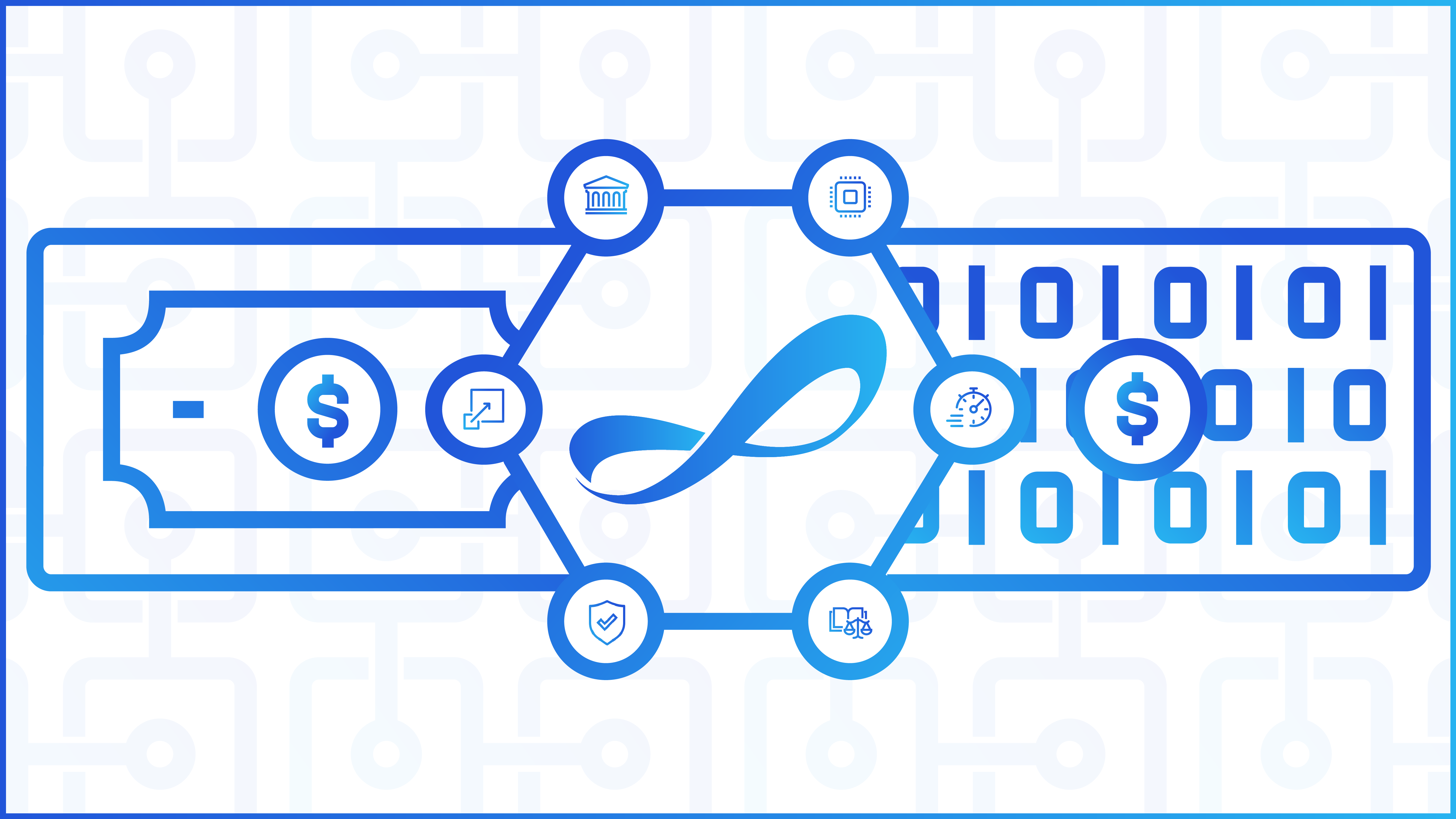
Stablecoins: The Rail Above Rails

Stablecoins, what started as an experiment, are now powering trillions of dollars every year1. They’re evolving from niche instruments into a critical layer of financial infrastructure, outpacing many traditional payment networks. That growth tells us something important: businesses and users alike are demanding faster, programmable, and globally interoperable ways to move money—capabilities that legacy systems simply can’t deliver.
Why does this matter? Because the way money moves today is still too complex. Multiple intermediaries, fragmented ledgers, and back-office processes slow everything down and add cost. While stablecoins offer a strong foundation, they largely exist in a separate world from where most money lives—creating a gap that limits adoption and keeps two systems apart.
Some companies have tried to close this gap through abstraction, essentially “wrapping” fiat and crypto providers, and orchestrating flows behind the scenes. This approach has helped boost adoption, but it comes with embedded assumptions and trade-offs. The best solution is full interoperability.
That’s what Cross River delivers. We’ve integrated stablecoins through direct integration with bank accounts inside our core banking system, making them interoperable with all other rails. Imagine receiving ACH and converting it into stablecoins within the same account or accepting stablecoin funding and pushing it to a card in real time. This is how we make programmable money practical, secure, and scalable.
The current banking infrastructure functions like a series of disconnected, pre-Internet corporate intranets. Within our domestic "walled gardens," legacy rails operate adequately, but they hit a hard stop at the network’s edge: banking hours, borders, and disparate tech stacks. To communicate outside these walls – whether across borders or even domestically between incompatible ledgers - we rely on fragile middleware that transfers instructions, not value. This creates a "break-fix" cycle where we manually map data fields and subjective codes, and any deviation results in rejected payments, operational friction, and user fees.
Stablecoins do not merely replicate these rails; they begin where our legacy infrastructure ends. While internal ledgers rely on probabilistic messaging, stablecoins utilize deterministic, open-source standards (like ERC-202) to deliver 24/7 settlement finality. They function as the "HTTP of finance" - a universal transport layer that bridges our fragmented intranets, allowing us to extend our liquidity and services into a global, always-on environment.
I spoke about this recently with Simon Taylor on his Fintech Brainfood Tokenized podcast. We explored how stablecoins act as an abstraction layer - a “rail above rails.” They don’t replace existing infrastructure; they complement it, creating a unified global payment layer that accelerates innovation while maintaining compliance. In practice, this abstraction enables interoperability, allowing value to move across both banking networks and blockchain rails in a consistent, predictable way.
At Cross River, we’re building the foundation for onchain finance, where payments, lending, and treasury operations all run on programmable infrastructure. That unlocks new capabilities: real-time liquidity management, tokenized assets that settle instantly, and credit that moves at the speed of software. These are the building blocks of the next generation of finance—open, efficient, and compliant by design.
The demand is clear: fintechs, enterprises, and crypto-native firms need infrastructure that bridges traditional finance and blockchain networks. Stablecoins are emerging as a first-class payment rail alongside RTP® and FedNow®, enabling programmability and interoperability that legacy systems struggle to keep up with.
And this is just the beginning. Beyond payments, the same infrastructure will support tokenization, smart contract-based settlement, and programmable credit. Five years from now, this will feel obvious. Twenty years from now, it will still be here.
Our mission is simple: make fiat and stablecoin flows fully interoperable, enabling businesses to operate globally with speed, security, and compliance. That’s the future we’re building at Cross River.
You can learn more about our stablecoin launch here and explore our broader crypto offering here.
Stablecoin‑enabled accounts are U.S. dollar deposit accounts held at Cross River Bank, Member FDIC. Stablecoin payment rails allow customers to send and receive funds in stablecoins to Cross River Bank’s native endpoints. Stablecoin transfers automatically convert to U.S. dollars and are reflected only as U.S. dollar balances. Cross River Bank does not provide cryptocurrency custody, and customers do not hold digital assets of any kind at the Bank. FDIC insurance applies only to U.S. dollar deposits held at the Bank. Stablecoins are not deposits and are not FDIC insured. U.S. dollar deposits are insured up to applicable limits.
1 Stablecoin Transactions Surge 47% to $20.2 Trillion in 2025
2 The ERC-20 standard explained