Retail Sales Beat; VIVA Lands $150Mn Credit Facility; Prism Data’s Series A

September’s hot PPI print. Retail sales beat expectations. Labor market is holding up. OCC introduces final GENIUS rule. Tech issues alarm security researchers. Ramp applies for trust bank charter. VIVA lands $150Mn credit facility. Prism Data’s $20Mn Series A. Binance.US looking to raise $100Mn.
We’ve entered into an agreement to acquire Accrue, continuing our expansion of our embedded finance offerings. Read the full announcement here.
Subscribe here to get our newsletter each Sunday. For even more updates, follow us on LinkedIn.
September’s Hot PPI Print
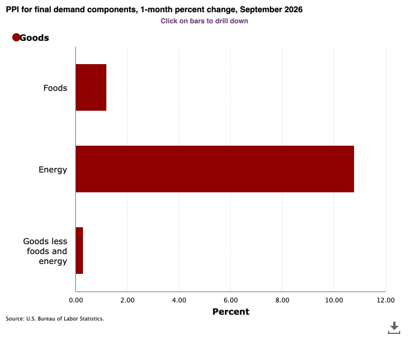
September’s producer price index data have renewed fears about continuing inflation. The print came in hot, with prices up 6.3% year over year. Unsurprisingly, energy costs were the biggest driver of the jump, the largest annual increase since 2022. The metric substantially exceeded a consensus estimate of 5.5%. U.S. retail sales were up 0.8% in September to $745Bn, topping expectations. Retail sales are measured on a nominal basis and measure total dollar expenditures, regardless of inflation. Still, the labor market is holding up. Initial jobless claims increased by 1,000 to 199,000. While earlier data showed the economy added just 29,000 jobs in September, with slowing population growth and immigration, fewer new jobs are needed to maintain a relatively stable unemployment rate.
OCC Introduces Final GENIUS Rule
The Office of the Comptroller of the Currency advanced rulemaking to implement the GENIUS Act. The final rule, proposed last week, spells out all the regulations the OCC is required to create to implement the stablecoin law. The rule lays out activities permitted for stablecoin issuers licensed under the law and standards and requirements for reserve assets, redemption, risk management, and examination and supervision, among other things. However, not all stakeholders are happy with the outcome of the rulemaking, which, bank advocacy groups say, leaves ambiguity on the permissibility of the much fought over topic of paying yield or “rewards” related to stablecoins. While the GENIUS Act prohibits stablecoin issuers from paying yield, it doesn’t block other players in the ecosystem, like crypto exchanges, from doing so. The final OCC rule does not include a presumption from the agency’s initial proposal that certain arrangements between stablecoin issuers and third parties would violate the ban on paying yield. Instead, the OCC’s rule says, the agency will evaluate such arrangements on a case-by-case basis, leaving the door open for deals like the one between USDC-issuer Circle and crypto exchange Coinbase, in which Circle shares revenue generated from USDC’s backing assets with Coinbase. Coinbase, in turn, offers users rewards for holding USDC on the platform.
Tech Issues Alarm Security Researchers
Multiple information security and technology issues impacted financial services companies last week. PHP, a common open source programming language used in as many as 70% of the Internet’s websites, was revealed to have a major security flaw last week. PHP is a server-side scripting language that allows user-facing websites to interact with databases and application logic in order to generate and deliver webpages to users. The security flaw could permit bad actors to inject and execute malicious code. The flaws had firms, including banks and fintechs, rushing to patch the vulnerability as threat actors attempted to use AI tools to take advantage of the flaw.
Meanwhile, an outage of Google’s cloud computing services in the U.K. caused widespread outages in the country last week, including of British upstart bank Revolut. The incident caused disruptions to multiple Revolut services, including card payments, foreign exchange, top ups, and ATM withdrawals.
Ramp Applies for OCC Trust Bank Charter
Following on the news of its monster $1.85Bn funding round, business expense management startup Ramp announced it has filed an application with the OCC for a national trust bank charter. The company provided few details, beyond saying it would use the bank entity, if approved, “to offer fiduciary investment management and custody of digital assets.” The trust bank entity would not enable Ramp to directly hold deposits or make loans; Ramp partners with multiple banks, including Column, Sutton, Lead, and Celtic, to offer its products and services.
In other Ramp news, the company also announced it is acquiring treasury management startup Vesto last week. Vesto’s treasury management software helps finance teams view, manage, and optimize cash sitting across multiple bank accounts in a single interface. The acquisition will enable Ramp customers to more easily see, report on, forecast, and move funds held across their accounts.
VIVA Lands $150Mn Credit Facility
VIVA Finance, a payroll-linked lending platform, announced it has secured a new $150Mn credit facility to continue to grow its business. Viola Credit is providing the facility. VIVA offers users personal loans in which repayment is directly processed out of their payroll, thereby lowering credit risk. Jack Markwalter, VIVA founder and CEO, commented on the new debt facility, saying, “This strategic partnership with Viola Credit represents a major milestone for VIVA as we continue to scale our platform and expand our market footprint. Viola Credit’s deep expertise in fintech and structured finance makes them an ideal partner for this next phase of our growth.”
Prism Data’s $20Mn Series A
Cashflow underwriting startup Prism Data announced last week that it has raised a $20Mn Series A. Prism Data, which was spun off from credit card startup Petal, leverages bank account transaction data to help lenders better underwrite borrowers. The round was led by Story Ventures, with participation from FINTOP, Core VC, Obvious Ventures, Mana Ventures, and others. The round brings Prism Data’s total equity capital raised to date to $25Mn, including an earlier seed round. Concurrently with the funding announcement, the company announced a new AI-powered offering, Refract, to better analyze and category transaction data. Refract can “discern earnings from borrowed funds, refunds from income, and purchases from transfers, even when the same payment platform is involved,” the company said.
Binance.US Looking To Raise $100Mn
Binance.US is looking to raise $100Mn to expand its operations in the competitive U.S. market, Bloomberg reported last week. Binance.US operates separately from Binance, although Binance founder Changpeng Zhao is a large shareholder in both companies. Binance.US is targeting a $1Bn valuation for the raise, per Bloomberg’s report. Binance.US has lagged rivals, owing in part to a 2023 settlement with the Department of Justice that saw Zhao plead guilty to civil and criminal charges. Zhao served four months in prison related to the matter and was later pardoned by President Trump.
