National Debt Hits $40Tr; Astraeus Raises $10Mn; Stripe Acquires OpenRouter
.png)
National debt hits $40Tr. Bond yields spike. FOMC minutes show willingness for rate hikes. Treasury rolls out GENIUS rulemaking. CFPB to end consumer complaint narratives. Coastal Community Bank posts $42Mn Q2 loss. Astraeus raises $10Mn for “AI native” wealth management. Citigroup to launch bitcoin custody. Stripe acquires OpenRouter.
We built Automated Deposit Sweeps directly into COS, our proprietary banking core, because businesses should have a simpler way to offer expanded FDIC protection to their customers. Our VP of Digital Banking Products, Ibrahim Urooj Saeed, explains the benefits that this approach delivers to our partners and their end users. Read the full piece here.
New here? Subscribe here to get our newsletter each Sunday. For even more updates, follow us on LinkedIn.
National Debt Hits $40 Trillion
The total U.S. national debt passed $40Tr for the first time last week, more than doubling over the past decade as crisis response, defense spending, and tax cuts helped push deficits higher. In July, the Treasury reported a monthly deficit of over $432Bn, the highest since March 2021. The U.S. isn’t alone in facing elevated debt levels and one of their potential consequences: higher yields. Competing with so-called hyperscalers that have increasingly turned to debt, including the bond markets, to fund AI data center buildouts, the U.S. has seen bond yields rise. Yields on 30-year Treasuries hit a high of 5.34% last week, a nearly two-decade high.
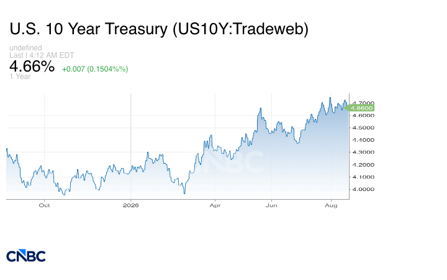
Treasury Secretary Scott Bessent announced the Treasury would double the size of its buybacks of long-duration date to at least $4Bn per operation, offering some relief. The intention is “to provide greater liquidity support in longer-dated nominal sectors where there is consistent strong sponsorship from market participants, as evidenced by the significant volume of high-quality offers Treasury routinely receives in longer-dated buyback operations,” the Treasury said in a statement. Yields on 10-year government bonds, which act as a benchmark for many consumer lending products, like auto loans and mortgages, dropped slightly from a 20-month high to 4.66% on the news.
Meanwhile, minutes from the most recent Federal Open Market Committee meeting, during which policymakers voted 9-3 to hold rates where they are, were released last week. Officials’ comments lay the groundwork for higher policy rates if inflation remains elevated. According to the minutes, “Some participants commented that financial conditions might not currently be sufficiently restrictive to facilitate a return of inflation to 2 percent.” Officials also discussed the prospect of holding fewer rate-setting meetings, with Fed Chair Kevin Warsh arguing holding six instead of the current eight meetings per year would be more efficient.
Treasury Rolls Out GENIUS Rulemaking
The Treasury Department rolled out a notice of proposed rulemaking last week to implement portions of the GENIUS Act. The proposal is seeking feedback on how Treasury would implement Section 3 of GENIUS, which prohibits the issuance, offer, sale, and availability of stablecoins to persons in the U.S. unless issued by a permitted payment stablecoin issuer. As of January 18, 2027, the anticipated effective date of GENIUS, entities may not issue a payment stablecoin in the U.S. without obtaining licensing as defined by GENIUS and relevant regulatory rulemaking. The proposed rule would also prohibit digital asset service providers, such as crypto exchanges, from offering or selling stablecoins to U.S. persons, unless issued by a licensed payment stablecoin issuer. The proposed rule would, among other things, define what it means to “offer or sell” and to “issue a payment stablecoin in the United States.” The public has 60 days to comment once the notice is officially published in the Federal Register.
CFPB To End Consumer Complaint Narratives
The Consumer Financial Protection Bureau plans to end its publication of consumer complaint narratives, the agency revealed last week. The CFPB will also sunset data visualizations based on data in its consumer complaints database. While the CFPB’s role in facilitating consumers’ complaints about providers and storing those complaints is required in law by Dodd-Frank, it is not a statutory requirement to make the consumer-written narrative portion publicly available. In removing consumers’ narratives, the CFPB has argued that the benefits are not outweighed by the challenges and negative impacts of making unverified, one-sided complaints public. The CFPB has suggested that such complaint narratives are not representative of typical consumer experiences and could mislead consumers.
Coastal Posts $42Mn Q2 Loss
When fintech partner bank Coastal announced its earnings at the end of last month, it swung to a surprise loss. Bank management explained the $42Mn net loss by pointing to the reduction in value of a credit enhancement asset and an increase in loan loss provisions associated with an unnamed fintech lending program. The charges associated with the program totalled $68.8Mn in the second quarter, leading to the overall loss. While Coastal didn’t specify the partner, Bloomberg reported the fintech in question is LendingPoint, a near-prime lender that offers unsecured installment loans at rates up to 35.99% APR. Bloomberg pointed to LendingPoint’s history of executive turnover and a mismanaged 2023 system conversion that resulted in one of LendingPoint’s bank partners, Midland States Bank, cutting ties with the lender. Midland ultimately wrote off $17.3Mn of its LendingPoint-originated portfolio, or nearly 20% of its outstanding loan book when the bank opted to sell the portfolio. For its part, Coastal said in its quarterly earnings that it remains dedicated to its banking-as-a-service business unit and, after a thorough evaluation of other partners, did not find any similar issues.
Astraeus Raises $10Mn For “AI Native” Wealth Management
Astraeus, founded by veterans of small-dollar lender and banking app MoneyLion, announced it has raised more than $10Mn to build an “AI-native” infrastructure platform for wealth managers. Investors in the round include Walkabout Ventures, Plug and Play Ventures, Fintech Collective, and F-Prime. Astraeus’ cofounders, Phill Rosen and Jon Stevenson, argue that AI will only succeed in changing wealth management if the business is built from the ground-up around it. A central piece of the Astraeus platform is its “semantic layer” and “ontology,” which, the company says, allows it to understand relationships between advisors, clients, accounts, products, policies, fees, and regulatory obligations. Rosen, the cofounder and CEO, commented on the raise, saying, “We built Astraeus to provide a unified infrastructure that understands how a firm actually operates and enables every decision, workflow, and process to benefit from that context.”
Citigroup To Launch Bitcoin Custody
Last week, Citigroup announced plans to launch a bitcoin custody offering before the end of the year. Citigroup’s “Custody+” platform plans to bring digital assets into the same type of account structure the mega-bank uses for traditional equities and bonds. While there are plenty of existing digital asset custodians, Citigroup is banking on the simplicity of being a one-stop shop, so to speak, and of being able to use the same custody framework across both traditional and digital assets. Customers will be able to leverage the same reporting tools and risk and compliance workflows across asset types, improving efficiency. Amit Agarwal, Head of Custody at Citi, commented on the announcement, saying, “Institutional investors no longer want to manage digital assets in isolation from their traditional book-of-record. Custody+ is the product of a multi-year commitment to building infrastructure that matches the speed of our clients' strategies.”
Stripe and Advent Discuss PayPal Acquisition
The PayPal/Stripe rumors were back in the news last week. The Wall Street Journal reported the web 1.0 payments giant is talking to Stripe and Advent about a possible acquisition. Last month, the two suitors proposed buying PayPal for $60.50 per share, an offer that PayPal felt was too low, according to the WSJ’s reporting. That proposal valued PayPal at about $53Bn, significantly above its market value of about $40Bn, but well below its COVID-era peak of more than $280Bn. The future of any possible deal remains uncertain, as recently installed PayPal CEO Enrique Lores continues to roll out a wide-reaching turnaround plan.
In other Stripe-related news, the payment processor has struck a deal to acquire AI infrastructure platform OpenRouter. The deal reportedly values three-year-old OpenRouter at $7Bn. OpenRouter offers a platform for directing and optimizing calls to artificial intelligence models, collecting about 5% per API call. Developers can access over 400 models from about 60 to 70 model providers through a single integration with OpenRouter, thereby allowing firms to save money by allocating a given task to the least-expensive model needed to successfully complete it.
