Inflation at 3.7%; OCC Debanking Report; DailyPay’s $200Mn ABS
.png)
September’s CPI print came in hot. Home sales hit a 12-year low. Consumer confidence drops. OCC publishes debanking report. Bank of America hit with enforcement actions. JPMorgan Chase warns on consumer AI agents. DailyPay completes $200Mn ABS. Ramp raises (again).
We’re partnering with Ripple to expand our stablecoin optionality and integrate RLUSD into our banking core infrastructure, with support for transactions on the XRP Ledger. Learn more about the partnership here.
Also, we’re excited to welcome our new President, Evan L. Russo, to help scale our platform and accelerate our new phase of growth. Read more here.
Subscribe here to get our newsletter each Sunday. For even more updates, follow us on LinkedIn.
CPI Jumped to 3.7% in September
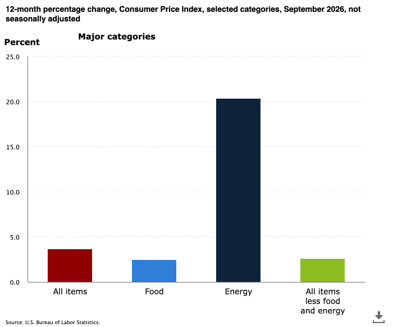
Inflation jumped to 3.7% last month vs. the year prior, with CPI up 0.6% month over month, last week’s Bureau of Labor Statistics data show. That makes a marked increase over August’s 3.4% year over year inflation rate and approaches double the Fed’s long-term target of 2%. Unsurprisingly, energy prices were a major driver of rising costs. Energy costs in September were up more than 20% vs. 2025 on a seasonally unadjusted basis. Excluding food and energy prices, CPI came in at 2.6%, still well above target. With continuing military action in the Middle East and the war in Ukraine, it seems unlikely the pressure on energy costs will ease soon, despite the announcement of a U.S. deal to import Russian diesel. The CPI print may increase the likelihood of additional interest rate hikes sooner than later. Rising interest rates have put a freeze on home sales, with pending sales hitting a 12-year low as mortgage rates exceed 7%. Given the above, it shouldn’t be a surprise consumer confidence dropped in October to 46.3, per the University of Michigan survey, approaching a record low.
OCC Publishes Debanking Report
The Office of the Comptroller of the Currency released its report on debanking last week. The OCC undertook the review following President Trump’s Executive Order 14331 on “Guaranteeing Fair Banking for All Americans,” intended to prohibit financial institutions from denying access to financial services on the basis of a person’s political or religious beliefs or lawful business activities. The supervisory review included nine of the country’s largest banks: JPMorgan Chase Bank, Bank of America, Citibank, Wells Fargo Bank, U.S. Bank, Capital One, PNC Bank, TD Bank, and BMO Bank. According to the OCC, between 2020 and September 2025, all nine banks had policies or practices that “may have required, encouraged, or otherwise influenced banks to deny or limit access to financial services to Americans because of their political or religious beliefs or lawful business activities.” Comptroller Jonathan Gould commented on the report, saying, “Americans should have access to financial services regardless of their beliefs, affiliations, or political views. Fair access to financial services is not a mantra—it is a mandate.”
Bank of America Hit with Enforcement Actions
Bank of America was hit with what the OCC described as its largest ever penalty, $750Mn, also related to AML and sanctions failures. The $750Mn OCC civil money penalty is included in a total of $1.21Bn in fines related to the enforcement action, which included actions from FinCEN and OFAC. FinCEN found that Bank of America failed to properly mitigate and report national security risks, including Chinese money laundering networks. The OCC penalty stemmed from the bank’s deficient and ineffective BSA/AML program. And the OFAC penalty was tied to apparent sanctions violations, including sanctions programs related to Iran, Russia, narcotics, and global terrorism.
JPMorgan Chase Says “No” to Consumers’ AI Agents
In a sign of how seriously banks are taking the potential risks of consumers’ use of AI agents, like Meta’s recently launched Muse, JPMorgan Chase said last week it is blocking such agents from directly accessing accounts at the bank. JPMorgan Chase CEO Jamie Dimon sounded the alarm about the risks of “rogue agents” operating at scale, and said the bank is building defensive tools to help it detect and mitigate such risks. The potential battle brewing over whether consumer-permissioned agents can access bank accounts and make transactions on their behalf is reminiscent of the “screen scraping” era of open banking, in which bank data aggregators would collect and use customers’ login information to access their data. While use of personal agents like Muse and Instinct is still nascent, the popularity of such tools is rapidly growing, raising a host of questions about how banks and merchants will handle transactions initiated by agents, particularly when those transactions don’t align with what a user intended to do.
DailyPay Completes Second Securitization
Earned wage access provider DailyPay has announced it completed a new $200Mn asset-backed securitization of its On-Demand Pay receivables. This marks DailyPay’s second issuance in the ABS market. According to the company’s announcement, it is the only EWA provider to date to tap the ABS market for funding. The offering included four classes of notes, which Morningstar DBRS rated from AA to BB. The latest securitization brings DailyPay’s total debt financing backed by its receivables to approximately $1.4Bn.
Ramp Raises (Again)
Business banking startup Ramp continues to raise money hand over fist. Bloomberg reported last week that the company had raised an additional whopping $1.85Bn. The round was co-led by Dragoneer Investment Group and Thrive Capital, with Founders Fund also putting in considerable capital. The new investment values Ramp at $60Bn. Ramp was valued at $44Bn when it raised $750Mn just four months ago in June. At that time, Ramp said it works with approximately 70,000 businesses, and Bloomberg reported Ramp’s annualized revenue exceeded $1.5Bn.
