The Wallet is the New Branch
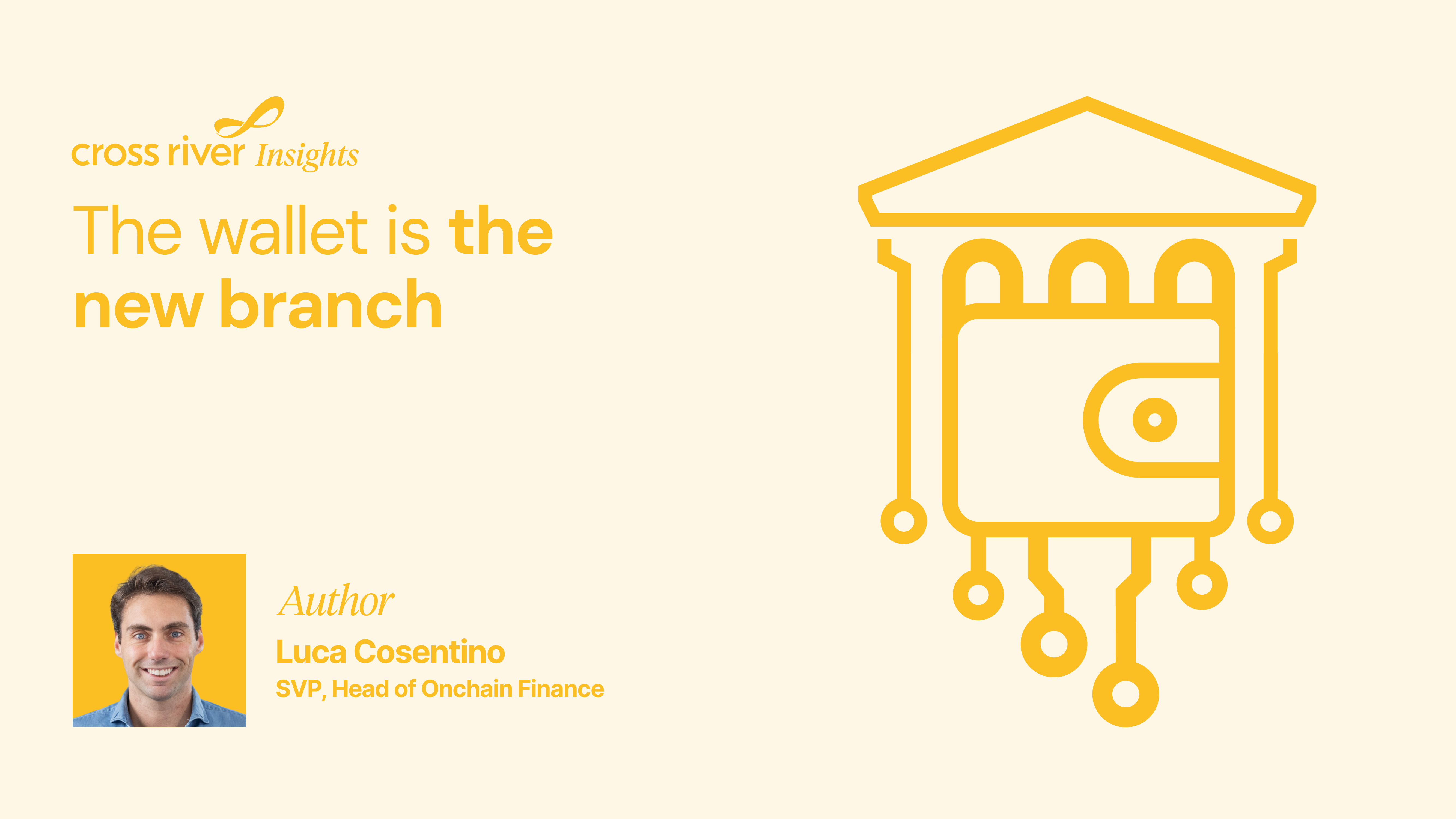
When identity, compliance, and money become programmable primitives, the account becomes infrastructure and the wallet becomes the interface.
Financial distribution has always moved in waves. Products that once lived behind a branch counter were unbundled by neobanks, then unbundled again by vertical fintechs that owned a single use case — payments, lending, deposits — better than any incumbent.
Each wave reached more buyers. None escaped the same constraint: the cost of building.
Every new product required different bank relationships, compliance architectures, and licenses. That cost made it hard to do more than one thing well. A handful of companies had the capital and the talent to expand horizontally and own more than one vertical at once. For everyone else, fragmentation was the price of entry.
The builder economics just changed
Three shifts are now dismantling that constraint.
First, money has become portable: a product can be built once and offered to a global audience from day one, instead of rebuilding market by market.
Second, blockchains reduce local fragmentation by being global and interoperable by default, creating one settlement layer instead of a patchwork of rails.
Third, the tooling to build sophisticated financial products is no longer concentrated in a few firms.
Together, these converge on one requirement: programmable infrastructure that natively carries identity, compliance, and settlement. The result is a step-change: lower cost to build, faster global rollouts, and less dependence on legacy plumbing.
Consider a marketplace that supports US-only creator payments and now wants to expand to LATAM and APAC creators. The standard approach is familiar: new banking partners in every region, bespoke compliance builds by geography, fragmented reconciliation across vendors, and months of integration work for each new corridor. By the time the third corridor goes live, the first corridor needs maintenance.
Current payments infrastructure is held together by reconciliation. Every new rail, region, or payment type adds another ledger to manage. Engineering effort goes toward stitching together disconnected systems, rather than building new products or scaling distribution.
On a unified layer, expansion works differently. Identity verification happens once and applies across regions. Compliance logic is reused, not rebuilt. A single ledger supports both fiat and stablecoins. Adding a third corridor takes weeks, not months, because the primitives already exist. Each new market adds leverage instead of complexity.
The wallet becomes the branch
When that layer exists, everything changes upstream. Identity, compliance, and settlement become reusable, programmable primitives: applied once and deployed globally. Payments, lending, deposits, and custody collapse into API calls. The wallet becomes the natural distribution layer, doing the job branches once did, but everywhere at once.
This leads to a fundamental shift in distribution: the wallet becomes the branch.
Most of the world never had the branch to begin with
In large parts of Asia, Africa, and Latin America, the wallet did not replace the branch. The wallet arrived instead of the branch. Hundreds of millions of people opened their first account inside a messaging app, a ride-hailing app, or a marketplace. Payments were instant and QR-based years before most Western consumers had a real-time option at all.
Two things made that work, and neither was a technology breakthrough.
The first was interoperability. Public instant-payment options made every wallet reachable from every other wallet, which turned wallets from closed loops into a network. Value accrued to the interface, not to the rail.
The second is the part US builders consistently underestimate: a second license category. In most of these markets, e-money and payment-institution permissions let a non-bank hold customer balances and move money, with safeguarding requirements in place of a full bank's capital regime. Cheaper, faster, narrower. That is why wallet penetration outside the US was built so much faster than it was in the US.
Those permissions shaped not only how wallets spread, but what they were built to do.
"The wallet becomes the natural distribution layer, doing the job branches once did, but everywhere at once."
The wallet’s purpose is not the same everywhere.
In Latin America, the wallet is primarily a store of value. The priority is preserving purchasing power in dollars. In Asia, the wallet is a working account, primarily a commerce tool that is optimized for moving money quickly and efficiently.
In these regions, it’s the same interface, different jobs. One market values protection and storage. The other values speed and movement. Any thesis that assumes wallets are simply replacing bank accounts misses that distinction.
While e-money is a great front door, it’s a poor balance sheet. Under most e-money regimes, balances can be moved but not fully deployed as deposits. They cannot readily provide the yield, credit, or protections that make long-term balances attractive. As a result, the most successful wallet providers eventually added a bank partner or banking license. Not because e-money failed, but because it reached its limits.
The answer is a mixed stack: e-money, banking licenses, and stablecoins
Running a mixed stack used to mean running two disconnected products, because a deposit and an e-money balance live on different ledgers, in different entities, on different clocks.
Stablecoins remove that seam. A stablecoin is a way to represent a balance and move it (24/7, across borders, on one ledger) independently of which legal wrapper the value started in or ends up in. Value can enter as a deposit, travel as a token, and land as a local e-money balance. The user experiences one continuous movement.
That is what makes stablecoins useful to both jobs at once. For the Latin American user, a dollar balance is reachable without an offshore relationship. For the Asian seller, cross-border settlement and conversion happen on the same rail rather than through a correspondent chain. Neither use case requires the user to hold a "crypto" position or think about one. The token is plumbing, not product.
The wallet is the interface
Which means the user should never know, or care, which wrapper sits behind which balance.
Behind a single interface: an insured deposit, an e-money balance, a stablecoin balance, a tokenized treasury position, a credit line. Different legal constructs. One experience.
This is what "the wallet is the branch" actually means. Not that the bank account dies. That it stops being the interface and becomes one of several instruments the interface can reach for. The account keeps doing the thing only a charter can do. It just stops being the thing the customer looks at.
A billion people now carry a full-service financial endpoint in their pocket, usable across any border. The customer endpoint is no longer a physical location, and it is no longer an account number.
Programmable, and therefore fluid
Once identity, compliance, and settlement are programmable primitives, money starts behaving according to rules rather than business hours and product boundaries.
An idle balance sits where it earns and is protected until the moment it is spent, then moves through whichever rail is cheapest and fastest for that corridor. A payout to a seller abroad lands in local currency or a dollar balance (their choice, same API call). Spending limits, savings behavior, currency conversion, and approval thresholds get expressed as policy and enforced at the transaction, instead of reconciled afterwards.
The consumer experience becomes fluid: fewer products to choose between, fewer transfers to initiate, less waiting. Not because the underlying financial system got simpler, but because the complexity moved to where it belongs: into infrastructure.
One caution: programmability moves risk rather than removing it. When money routes itself across license boundaries and jurisdictions, the routing rules become the product, and those rules are somebody's regulated obligation. Automating a compliance decision does not transfer responsibility for it. The infrastructure layer has to be regulated, not merely well-engineered.
What this leaves builders with
The old question was: which bank partner do I need in this market?
The new question is: which primitives do I need, and who can carry them across every market I intend to enter?
The wallet is where those primitives surface to the customer. Everything else (the charter, the e-money permission, the ledger, the rail) is implementation detail the user should never have to see.
As I've said previously: features are getting cheap. Primitives are not.