“Skinny” Master Accounts; X Money Launches; Cordant Emerges from Stealth
.png)
Fed holds rates steady. Unemployment numbers beat expectations. Community banks push back on “skinny” master accounts. Wall Street supports passing CLARITY. Wise’s charter app declined. Upstart receives OCC conditional approval. Flex files for an ILC. X Money officially launches. Cordant emerges from stealth.
People manage their money on the platforms they already use. Our Head of Fintech Solutions, Lynn Chen, shares how embedded finance is transforming social platforms and what this shift means for users, businesses, creators, and the platforms themselves. Read the full piece here.
New here? Subscribe here to get our newsletter each Sunday. For even more updates, follow us on LinkedIn.
Fed Holds Rates Steady on 9-3 Vote
Some see the Federal Reserve entering something of a new, potentially more contentious era under recently confirmed Fed Chair Kevin Warsh. At last week’s FOMC meeting, the second under Warsh’s tenure as chair, the Fed held rates steady at 3.5% to 3.75%. But the 12 member FOMC voted 9-3 to do so, more dissent than historically has been the norm. Fed Governor Waller, Minneapolis Fed President Neel Kashkari, and Cleveland Fed President Beth Hammack have all recently expressed support for higher rates, should inflation remain elevated. Dallas Fed President Lorie Logan said rates should be “modestly” higher.
At the same time, Fed Chair Warsh has made an explicit break with prior Fed Chairs by providing less forward guidance on how the central bank is thinking about rate policy. Following last week’s rate decision, Warsh commented, “I understand the desire for rolling forecasts and commentary from this committee, but for our part, we need to observe market reaction to developments direct and unfiltered. I want to stress, of course, that decisions by this committee matter a great deal, and where necessary and appropriate, we will not hesitate to act.” Still, despite the Fed’s decision to hold rates steady, yields on 30-year Treasuries jumped, exceeding 5.2%, the highest level since 2007.
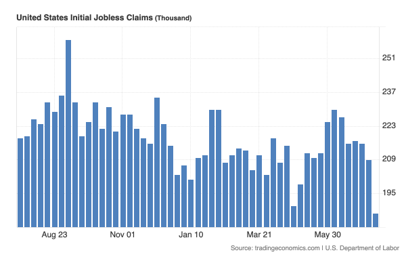
While the economy faces renewed uncertainty around inflation, owing both to the ongoing war in Iran and cost pressures from AI data center build outs, top line employment numbers continue to hold up. New weekly unemployment applications for the week ending July 18th dropped by 22,000 to 187,000, coming in significantly below analyst estimates of 215,000. Per Bureau of Labor Statistics data, that’s the lowest level of initial unemployment claims since 1969.
Community Banks Push Back on “Skinny” Master Account Proposal
Comment letters on the Federal Reserve’s “skinny” master account proposal were due last week. The accounts, which would offer a subset of the features and capabilities typically available to an insured depository institution, have rankled some advocates representing the traditional banking sector. Master accounts, which have historically been a relatively niche topic, have become something of a hot-button issue in recent years, as non-bank fintech and crypto firms seek more direct access to payment rails. Presently, these firms would need to partner with a regulated bank to utilize payment rails like ACH and wires. Still, the “skinny” master account, even if approved, isn’t likely to be a panacea. Under the current proposal, nonbank firms would have access to the Fedwire Funds Service, the National Settlement Service, FedNow, and Fedwire Securities, enabling them to process payments and securities transfers directly with the Fed, rather than relying on a bank partner. However, the current proposal does not include ACH, which remains a workhorse payment rail for processing common transactions like payroll, bill payments, and direct deposits. Some comment letters from banks argue the “skinny” master accounts would give more lightly regulated fintechs and crypto firms an unfair advantage and are asking the Fed to explicitly clarify the limited accounts would not pave the way for access to a full master account. Meanwhile, fintechs and crypto firms are pushing for broader access than the Fed lays out in its proposal, including access to ACH and higher end-of-day balance limits.
Wall Street Comes Out In Support of CLARITY Act
The proposed CLARITY Act has revealed some notable fault lines. The legislation, which made it out of the Senate Banking Committee but does not yet appear to have enough committed support to clear the 60 vote threshold needed in the Senate, would broadly define market structure for crypto assets, including by dividing regulatory oversight responsibilities between the CFTC and the SEC. The two key blockers at this point are ethics provisions that would restrict senior government officials from being involved with certain crypto projects or activities and the question of stablecoin “rewards.” The rewards question is something of a holdover from last year’s GENIUS Act, which banking industry lobbies argued left a significant loophole for entities other than stablecoin issuers, such as distribution partners, to pay rewards. The concern is that allowing distribution partners, like crypto exchanges and wallets, to offer such rewards could displace deposits from the traditional banking system, thereby reducing institutions’ ability to lend. That makes it all the more notable that a handful of Wall Street names expressed their support for getting the CLARITY Act over the finish line. Specifically, BlockRock, Fidelity, Franklin Templeton, Goldman Sachs, and SoFi publicly endorsed the bill last week. The group argued that clear rules for crypto would better protect investors while helping the U.S. stay competitive in the digital asset space. Still, it’s worth noting that, with the exception of SoFi, these firms are more focused on investment and asset management vs. deposit gathering and lending, meaning they may have more upside from CLARITY passing, with less or no risk from potential deposit displacement.
Charter Watch: Wise, Upstart, Flex
The last couple of weeks have brought several updates on the bank charter front. The most notable development is arguably the OCC’s decision to publicly deny Wise’s application to charter a national trust bank. Typically, applicants will be allowed to withdraw charter applications, rather than having them officially and publicly declined. In its letter, the OCC pointed to Wise’s AML issues, including a multistate settlement reached about a month after the remittance company filed its charter application. Wise paid a $4.2Mn penalty as part of the multistate action. The OCC’s denial letter highlighted that Wise’s application did not address “key deficiencies” in its proposed AML/CFT program and that the proposed entity’s organizers and the proposed board and management lacked familiarity with national banking laws and regulations. Wise, which is publicly traded, saw its shares drop about 10% on the news.
Meanwhile, Upstart received conditional approval from the OCC on its application to charter Upstart Bank, N.A. The company’s associated applications to the FDIC, for deposit insurance, and to the Federal Reserve, to form a bank holding company, remain pending. According to the company’s news release announcing the conditional approval, “The charter would allow Upstart to reduce operational, regulatory, and financial complexity for itself as well as for its third-party capital partners.” Upstart’s bank subsidiary will be based in Delaware and will not have any physical branches, the company has said.
Finally, Flex, which offers buy now, pay later-style plans for rent, mortgage, and bill payments, announced it has filed an application to charter an industrial bank, with the Utah Department of Financial Institutions, and a corresponding deposit insurance application with the FDIC. Flex says that, to date, it has processed more than $40Bn in rent payments for 3.2Mn renters, helping them avoid more than $780Mn in late and penalty fees. If approved, Flex Bank would serve as the issuer of Flex’s credit products, as well as offering deposit accounts. Flex currently partners with Lead and Column and holds various state licenses. Flex cofounder and CEO Shargie Lichtenstein commented on the application, saying in part, “A bank charter allows us to build directly on a foundation of federal deposit insurance and full state and federal bank regulatory oversight, strengthening the products millions of renters already rely on… This charter gives us a permanent, regulated foundation to keep closing that gap.”
X Money Officially Launches
X, formerly known as Twitter, officially launched its X Money service last week, though it is available on an invite-only basis for the time being. X Money is offering up to 6% APY on deposits and 3% cashback on eligible purchases. To qualify for the 6% rate, users must deposit at least $1,000 and pay for X’s premium tier, which runs $8 per month. X Money users will be able to send peer-to-peer payments to other users on the platform, making it the first social media platform in the U.S. with a fully embedded banking experience. X Money is partnering with Cross River to bring that experience to users within X’s ecosystem.
Cordant Emerges From Stealth
Cordant, a “command center” for payment infrastructure, emerged from stealth last week and announced it has raised an $8Mn seed round. The seed round was co-led by Motive Partners and Oak HC/FT. The company, led by a team of four former employees of Rapyd, is tackling the challenge of coordinating payment workflows that cross multiple systems of record. Cordant achieves this by normalizing transaction data across systems in order to detect gaps and contradictions. Crypto firms Paxos and Bitso are serving as design partners, as well as investors in the seed round. Cordant cofounder and CEO Eric Rosenthal commented on the launch, saying, “Money moves in real time, but understanding where a transaction went, which systems and partner acted, who authorized it and whether the records agree still depends on weekly and monthly reporting.”
