PCE Up 3.7%; New CFPB Acting Director; Chime Ups Earnings Forecast
.png)
PCE up 3.7% year over year. Fed officials warn on inflation concerns. Consumer confidence slips. FDIC working on fintech partner standards. A new CFPB acting director. Chime ups revenue forecast, lays off 10%. Augustus gets FDIC OK. Maximum raises $30Mn seed round.
We stress-tested our proprietary banking platform, COS, against future volume projections long before those demands arrived. Our Chief Technology Officer, Joel McCormick, explains the proactive architecture decisions that strengthened COS into what it is today. Read the full piece here.
New here? Subscribe here to get our newsletter each Sunday. For even more updates, follow us on LinkedIn.
PCE Up 3.7% Year over Year
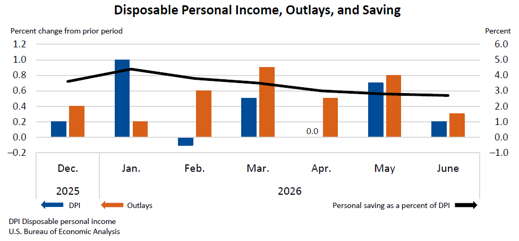
Personal income jumped by nearly $55Bn in June, according to the Bureau of Economic Analysis’ latest data, released at the end of July, while personal consumption expenditures increased by $65.2Bn. The PCE price index in June increased 0.1% month over month (both including and excluding more volatile food and energy costs). Year over year, PCE jumped by 3.7%, or 3.3% without food and energy expenses. The PCE data add context to warnings from Federal Reserve officials about the potential need for rate hikes to combat inflation. Last week saw multiple Fed officials warn that rates may need to increase if inflation isn’t on a sustainable path back towards the Fed’s long-term 2% target. Fed Governor Lisa Cook, who voted to hold rates steady at the most recent FOMC rate setting meeting, warned that the longer the Fed waits, the more challenging it will be to get inflation under control. San Francisco Fed President Mary Daly made similar comments last week. While Daly said she was “completely supportive” of the July decision to keep rates where they are, she also warned that stubborn inflation could require a more robust response from policymakers.
In other Fed news, the Wall Street Journal reported last week that President Trump has spoken with recently confirmed Fed Chair Kevin Warsh, citing people familiar with the matter. Trump has asked Warsh about how matters ranging from the Iran war to the explosive growth of AI are impacting the economy, the WSJ reported. Such ongoing communication between Fed chairs and the President is a departure from precedent. It is not clear if Trump and Warsh have discussed monetary policy, specifically, the report said. Meanwhile, consumer confidence dipped in July, according to the latest data from The Conference Board. Consumer confidence declined slightly in July, to 90.8, from an upwardly revised 92.2 in June. Consumers’ perceptions of the employment climate remained weak, despite overall employment metrics that suggest a reasonably healthy labor market.
Fed Pilots Survey of Private Credit Markets
As the role of private credit in the U.S. economy has grown, so too has policymakers’ interest in understanding this relatively opaque sector. The Federal Reserve Bank of Dallas and the Federal Reserve Bank of New York are looking to change that. The two regional Fed banks are teaming up to launch a pilot survey to collect data on the U.S. private credit market. The survey aims to provide additional insight into the availability of credit, credit provision, changing lending standards, and the impact of the economy and monetary policy. The survey will segment the direct lending market according to borrower size, looking at the lower-middle market (<$30Mn EBITDA), the middle market ($30Mn-$100Mn EBITDA), and the upper-middle market (>$100Mn EBITDA). The first survey is expected to launch toward the end of Q3 2026, with aggregate findings published in early 2027.
FDIC Working on Fintech Partner Standards
The FDIC is looking to make it easier for banks to partner with fintechs by working with industry trade groups to establish a standard setting body, Bloomberg Law reported last week. A key goal of such an organization would be to help banks, particularly smaller community banks popular with fintechs, to avoid duplicative due diligence work that banks typically must undertake to meet third-party risk management expectations. Such a standard-setting organization could also assess and certify whether or not third-party firms meet the organization’s standards. A clear standard “would address these inefficiencies by standardizing and certifying common third-party risk management (TPRM) information that can be assessed once, refreshed over time, and reused by multiple banks, while preserving each bank’s responsibility for institution-specific risk assessment, contract decisions, integration, monitoring, and oversight,” the FDIC’s proposal said, according to Bloomberg Law’s reporting.
In other FDIC-related news, the regulator officially launched its new Office of Supervisory Appeals. The OSA is comprised of independent officials who will evaluate and resolve entities’ appeals of material supervisory determinations. The OSA replaces the Supervision Appeals Review Committee. The FDIC concurrently announced the appointment of three individuals who will serve as reviewing officials: Tim Ayala, John Conneely, and Duke Sheow. The FDIC also published a Financial Institution Letter, providing instructions for FDIC-supervised institutions that seek to appeal supervisory determinations.
New CFPB Acting Director
The Consumer Financial Protection Bureau has a new acting director. CFPB Deputy Director Mark Paoletta has stepped up to serve as the CFPB’s acting director, as Russell Vought’s time in that role was limited under the Federal Vacancies Reform Act. President Trump has nominated someone to fill the director role on a permanent basis, CFPB and Capital One veteran Brian Johnson. The Senate Banking Committee held a confirmation hearing for Johnson on July 23rd but has yet to vote on his nomination. If the Senate Banking Committee votes in favor of his nomination, Johnson would still require a vote before the full Senate.
Chime Ups Revenue Projects, Lays Off 10% of Staff
Chime announced that it has raised its full-year 2026 revenue forecast last week. The neobank is now forecasting revenue growth of 25%-26% this year vs. 2025, compared to an initial forecast of 22.7% growth. Chime is now forecasting Q3 revenue of $680Mn to $690Mn, above the consensus forecast of just over $668Mn. Chime shares rose 8% on the news. The company concurrently announced the departure of long-time CFO Matt Newcomb. Newcomb spent more than a decade at the company, including leading Chime through its IPO. Separately, the company announced it is cutting about 10% of its workforce, or about 150 employees. Chime CEO Chris Britt cited efficiencies from AI to explain the layoffs in a memo to staff, reported by Reuters. “AI is changing what's possible but requires new skills. Smaller teams with fewer layers are moving faster than ever and getting more done,” Britt said in the memo.
Augustus Gets FDIC OK
Augustus, which received conditional approval of its charter application from the OCC in May, has secured FDIC approval of its associated deposit insurance application. Augustus has positioned itself as a tech- and AI-first global dollar clearing bank. “We're building the Global Dollar Bank — direct, programmable dollar access for financial institutions around the world. Every approval brings that closer, and reflects the care we're putting into building it on solid foundations,” the company wrote in a post announcing the FDIC’s approval of its application. Per the FDIC’s approval, Augustus will launch with a minimum of $73.7Mn in capital and maintain a leverage ratio of 10% or greater.
Maximum Raises $30Mn Seed Round
There’s a new core banking startup in town. Maximum has emerged from stealth and announced a $30Mn seed round. The fundraising was led by CRV with participation from Restive, Plug and Play Ventures, Anthemis, and Pear VC. Maximum is led by three-time founder Randy Fernando, who previously sold his startup Vault to investing startup Acorns and another company he founded, Power, to issuer-processor Marqeta. Maximum looks to challenge the dominance of the “big three” legacy core providers, FIS, Fiserv, and Jack Henry. Fernando described the challenge, saying, “For decades, banks have attempted to serve the evolving needs of customers on infrastructure that was never designed for today’s world. The advancement of AI is creating a paradigm shift in financial services, and banks can’t keep pace by relying on legacy providers. Maximum will provide banks with ultimate control, powerful agentic capabilities, and the tools to innovate, enabling them to deliver exceptional new experiences to their customers and partners.”
