Lackluster Job Numbers; California Expands CFL; Polymarket Raises $1Bn

G20 finance ministers meet amid war, bond market turmoil. Job market remains lackluster. Congressional Republicans float CFPB changes. California expands scope of CFL requirements. Banks team up on another stablecoin consortium. TabaPay acquires a bank. Polymarket raises at a $21Bn valuation. Cari raises $32.5Mn for bank-led blockchain.
We will be in DC throughout Stablecon. Catch sessions from our Chief AI Officer, Pravesh Rijal, and Head of Onchain Finance, Luca Cosentino, on building trusted infrastructure for agentic commerce, and on compounding value across markets by building one accessible, interoperable layer for every corridor.
New here? Subscribe here to get our newsletter each Sunday. For even more updates, follow us on LinkedIn.
Wars, Bond Yields Keep Investors On Edge
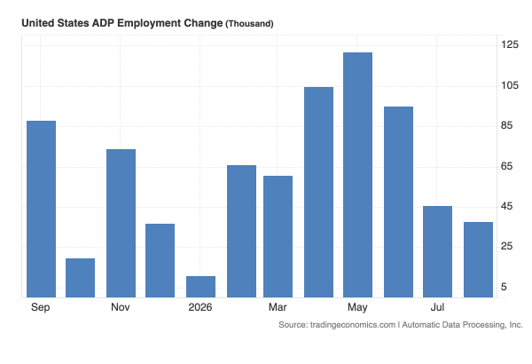
Finance ministers from the G20 met in Asheville, North Carolina, last week. Items on the agenda included the ongoing conflicts in Ukraine and Iran, the impacts of AI and the massive amounts of money being spent on associated data center build outs, and the recent global spike in government bond yields. The yield on U.S. 10-Year Treasuries reached just shy of 4.8% last week, before retreating slightly. The massive amount of debt being issued to finance AI data center build outs is widely believed to be contributing to rising government yields, as private issuers compete with governments in the debt markets. IMF Managing Director Kristalina Georgieva warned higher yields rising yields aren’t just a problem for lower-income countries, telling Reuters that elevated debt levels and stubborn inflation pose a real risk for advanced economies. Meanwhile, the latest Bureau of Labor Statistics’ JOLTS data for July showed job openings roughly flat vs. June, with 7.3Mn open roles in July. ADP’s August report showed private payrolls increased by just 38,000, below the consensus estimate of 47,000.
Congressional Republicans Propose CFPB Reforms
Republicans in Congress introduced legislation that, if passed, would significantly reshape how the Consumer Financial Protection Bureau operates. The measure, H.R. 10184, was introduced by House Financial Services Committee Chair French Hill (R-AR) and Congressman Andy Barr (R-KY). Hill described the proposed measure as establishing “durable guardrails” governing the CFPB. One aspect the bill seeks to address is how the bureau is funded, which has been the subject of multiple legal challenges over the years. Dodd-Frank, which created the CFPB, defined the bureau’s funding as coming from the Federal Reserve. H.R. 10184 would replace this mechanism, requiring the bureau to be funded through the typical Congressional appropriations process. The bill would also impose additional constraints on CFPB rulemaking, by requiring additional cost-benefit analysis, as well as establishing a CFPB-specific inspector general and tweaking how the treatment of money in the bureau’s Civil Penalty Fund.
California Expands Scope of CFL Requirements
Late last month, the California legislature passed a bill that would expand the scope of the existing California Finance Law licensing requirements. Currently, entities that offer certain commercial non-loan financing products, like invoice factoring and merchant cash advances, are not required to be licensed under the CFL. The bill, which California Governor Gavin Newsom is expected to sign, would require any business providing or brokering “commercial financing” to obtain a license in the state. The bill explicitly includes accounts receivable purchase transactions, including factoring, asset-based lending transactions, commercial loans, commercial open-end credit plans, and lease financing. The license requirement would also apply to entities that partner with depository institutions to extend commercial financing in the state.
Twenty-One Banks Team Up on Stablecoin Initiative
A group of 21 banks, including major names like Citi, Goldman Sachs, and Bank of America, are teaming up on a stablecoin. The move comes as rulemaking required under the GENIUS Act, passed last year, is progressing across the relevant federal financial regulators. The consortium’s effort will focus on commercial customers, rather than the retail users, the Wall Street Journal has reported. While the initial effort is focused on a US dollar-denominated token, WSJ reported future plans could include tokens pegged to the value of other G7 currencies. The effort is one of a multitude from incumbents to blunt the encroaching threat of potential deposit flight to stablecoins, which could accelerate as the requirements and licensing under the GENIUS Act are implemented.
TabaPay Acquires Colorado Bank
Payment processing platform TabaPay announced it has raised a fresh $155Mn in funding. The round, led by FTV, consists of primary capital and a secondary transaction. The company did not disclose a valuation tied to the round. Concurrently, TabaPay also announced it will acquire Colorado-based OCC-chartered Transact Bank, pending regulatory approvals. TabaPay intends to rename the bank as TabaBank, which will operate alongside the company’s existing TabaPay business and under a newly created bank holding company, TabaHoldings. TabaPay currently partners with multiple banks to power its payment processing platform. The company said the pending acquisition of Transact Bank would complement, rather than replace, its existing bank partnerships. TabaPay cofounder and CEO Rodney explained, saying, “The planned launch of TabaBank will bring payments and banking capabilities under one roof, offering our clients a more integrated experience while continuing to work alongside our network of bank partners. Together, TabaBank and FTV’s investment will expand our capabilities and help keep TabaPay at the forefront of payment innovation.”
Polymarket Raises $1Bn at $21Bn Valuation
Prediction market Polymarket has raised $1Bn at a valuation of $21Bn. The round included a $300Mn investment from 1789 Capital, a venture firm led by President Trump’s son, Donald Trump, Jr. Polymarket’s valuation jumped 40% from its most recent funding round earlier this year. Arch rival Kalshi raised $1Bn earlier this year at an ever-so-slightly higher valuation of $22Bn. The two firms were earlier movers in the prediction market space, moving to take advantage of legal ambiguities and a more favorable federal regulatory climate, even amidst pushback from state regulators and attorneys general. A number of state regulators view some of the event contracts on prediction markets as little more than sports betting in disguise, and argue that the states, not the CFTC, have the authority to regulate such activities.
Cari Raises $32.5Mn for Bank-Led Blockchain
Cari, which describes itself as a “digital money network,” has raised $32.5Mn in its first external capital raise. The funding came entirely from banks, rather than venture funds, which, the company says, demonstrates the support it has from its banking design partners. Cari’s design partners include First Horizon, Huntington, KeyBank, M&T Bank, Old National Bank, and SouthState Bank. Glacier Bank also invested alongside the six design partners. Cari is developing shared blockchain infrastructure that will enable banks to offer faster, 24/7, programmable money movement within the regulatory perimeter and while maintaining primacy in customer relationships. Cari founder and CEO Gene Ludwig commented on the milestone, saying, “From day one, we’ve believed that banks should be at the center of how digital money evolves, not adapting to infrastructure built without their input or influence. The fact that our first outside capital comes entirely from banks speaks volumes about what we’ve accomplished together and the opportunity ahead.”
