Inflation Jumps; CLARITY Act Progress; Slash Raises $100Mn
.png)
Inflation jumped in March. Rate cuts on hold. CLARITY Act progress. Executive order on banks collecting citizenship info. OCC plans to preempt Illinois interchange law. Slash raises $100Mn. Synctera acquires Cable. OpenAI makes a PFM acqui-hire.
Treasury teams are losing days to settlement delays and reconciliation gaps. Our VP of Crypto Product, Cecilia Rogers, explains in her newest Insights piece what a stablecoin-enabled account actually fixes.
New here? Subscribe here to get our newsletter each Sunday. For even more updates, follow us on LinkedIn.
Inflation Jumped In March
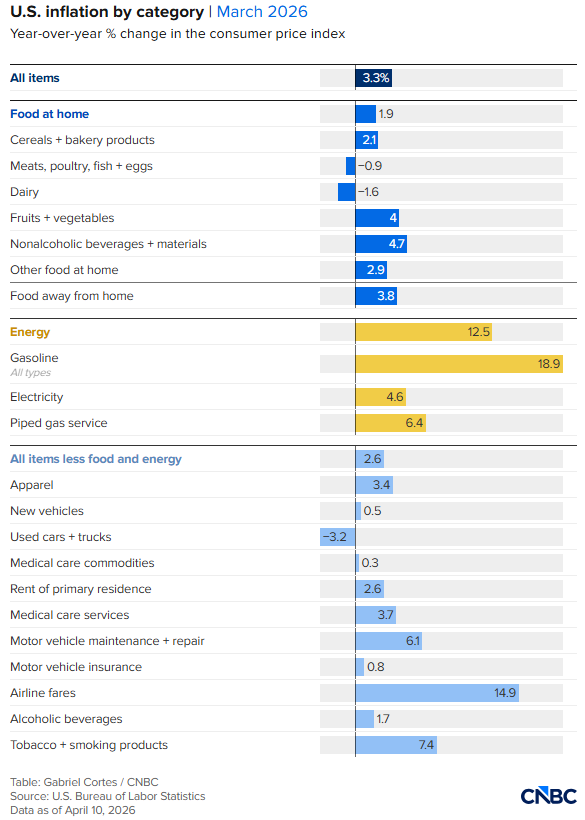
Last week, New York Fed President John Williams spoke about the potential knock-on impacts of the Iran war on the U.S. economy. Williams expressed concern that supply chain disruptions, particularly to oil, will slow economic growth and cause inflation to accelerate. “This has begun to play out already,” Williams said in prepared remarks last week. Indeed, the consumer price index for March jumped 3.3% year-over-year, a sharp increase from February’s 2.4%. While gasoline and airfare showed the biggest jumps in March vs. the year prior, higher energy costs may cascade through the economy, potentially pushing prices higher across a wide array of goods and services. The upshot seems to be that rate cuts some were hoping for may be on pause. Cleveland Fed Beth Hammack pointed to the challenge of balancing between risks to employment and inflation, saying, “I think there’s risks that we might need to be more accommodative or more restrictive, depending on how the data comes out.”
CLARITY Act Progress
The CLARITY Act, often referred to as crypto “market structure” legislation, may be nearing the finish line, according to various reports last week. JPMorgan Chase, the largest U.S. bank by assets, suggest there are signs stakeholders are nearing a breakthrough, though unresolved issues remain. The most visible point of friction has been the permissibility of stablecoin “rewards,” which, bank trade groups argue, would encourage deposit flight from the banking system, reducing banks’ capacity to lend. The CLARITY Act is also intended to define how responsibility for regulating and supervising digital assets, including stablecoins, is shared between the SEC and CFTC. Still, getting any legislation to the President’s desk in the current environment – and as midterm elections approach – may be a challenge.
Bessent Says E.O. On Collecting Citizenship Info in the Works
U.S. Secretary of the Treasury Scott Bessent reiterated last week that the government is considering options to require banks to collect citizenship information on their customers. The comments came at last week’s Invest in America Forum. Bessent indicated last week an executive order is in the works that would purportedly provide legal justification for the requirement. While regulations like the Bank Secrecy Act and PATRIOT Act do require covered institutions to collect “Know Your Customer” information, that does not currently include account holders citizenship information. Bessent pushed back on the current approach, saying, “Why can unknown foreign nationals come and open a bank account? Our bank executives job is to know your customer. How do you know your customer if you don’t know if they have legal or illegal status, whether they are a U.S. citizen or green card holder?”
OCC Plans to Preempt Illinois Interchange Law
The Office of the Comptroller of the Currency plans to try to preempt an Illinois law that would prohibit charging interchange on taxes and tips. The OCC submitted a notice to the Office of Information and Regulatory Affairs that indicates there is an executive order under review on the topic. The filing does not include proposed language of the prospective executive order. Per the OIRA site, the filing is at the “interim final rule” stage. The Illinois law, signed by Governor J.B. Pritzker, has proven to be controversial, with an array of stakeholders weighing in against it for a variety of reasons, including logistical difficulty in implementing and complying with the law. However, Robb Karr, the president and CEO of a trade association representing Illinois merchants, who favor the law as it stands to lower their payment processing costs, weighed in, saying, “This rushed announcement by the federal government to usurp Illinois law is unprecedented, prioritizing the bottom line of banks and credit card companies over meaningful relief for businesses and consumers.”
Slash Raises $100Mn Series C
Slash, a business banking startup, announced it has raised a $100Mn Series C. The round was led by Ribbit Capital and co-led by Khosla Ventures and Goodwater Capital. The latest funding round values Slash at $1.4Bn, making the company a “unicorn.” Slash claims to have surpassed $250Mn in annualized revenue in 2025 and processed more than $1Bn in annualized stablecoin payment volume within nine months of launching its stablecoin-based offering. Commenting on the fundraise, Slash cofounder and CEO Victor Cardenas said, “This round lets us build the next layer of what Slash can do: more industries, more markets, more of the financial tools businesses actually need. The support from Ribbit, Khosla, and Goodwater is invaluable and will enable us to build what’s next, faster.”
Synctera Acquires Cable
Banking-as-a-service platform Synctera has acquired compliance tech startup Cable. Cable automates control testing, also known as “second line” compliance, to help institutions verify their controls are working as intended. The acquisition augments Synctera’s existing platform, which helps to connect banks and their fintech programs. Synctera cofounder and CEO Peter Hazlehurst commented on the acquisition, saying, “Synctera has always focused on helping banks and fintechs build and scale responsibly. But execution alone isn't enough. Banks need visibility into how those systems are performing in real time. Cable provides that missing observability layer, giving our partners confidence that controls are working as intended across their entire fintech ecosystem.” The Cable team will join Synctera, and Cable will continue to be available as a stand-alone offering.
OpenAI Makes A PFM Acqui-hire
OpenAI has acquired personal finance startup Hiro. Hiro, founded by Ethan Bloch, who also was behind fintech company Digit, described itself as an AI-powered personal CFO. Terms of the deal were not disclosed, and, per a message of Hiro’s site, the service will shutdown on May 13th. TechCrunch described the deal as an “acqui-hire.” Hiro makes for OpenAI’s second PFM-type acquisition, following its purchase of finance app Roi last October.
