Fed Holds Steady; BitGo IPOs; Affirm Files for ILC
.png)
The Fed, as expected, held rates steady. Consumer confidence drops. Card delinquencies decrease. Zocks, Mesh, and Mine all announce new rounds of funding. BitGo IPOs. Capital One to acquire Brex. Affirm files for Nevada ILC charter. Ford and GM get deposit insurance approval. Revolut changes U.S. bank charter plans (again).
Missed our 2026 prediction webinar? Our leaders unpack the rise of full‑stack banking, borderless expansion, everyday embedded finance, and the real-world arrival of tokenized banking. Watch the full recording.
New here? Subscribe here to get our newsletter each Sunday. For even more updates, follow us on LinkedIn.
Fed Holds Steady in 10-2 Vote
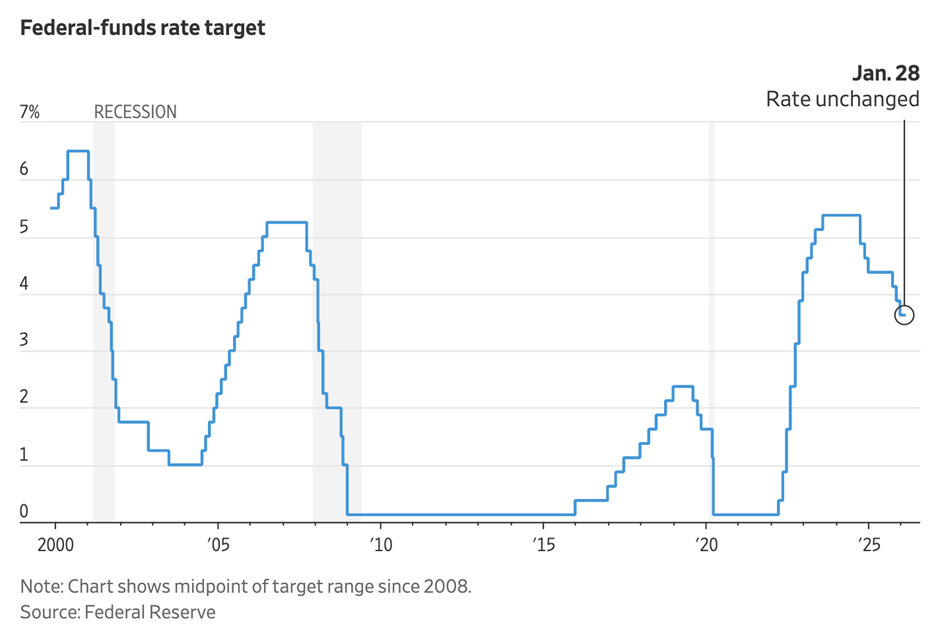
With all eyes on the Federal Reserve lately, the central bank has decided to hold interest rates where they are, for the time being. The Fed expressed a cautious approach, given a softening job market amidst elevated rates of inflation. The FOMC voted 10-2 to hold rates at the current 3.5% to 3.75% range. The decision was widely anticipated, and market response was muted, with the benchmark 10-year Treasury nudging up slightly and major stock indices unmoved by the announcement.
While rates held steady, consumer confidence is not. The Conference Board’s gauge dropped to 84.5 in January, the lowest level in more than a decade. Consumers remain concerned about the employment market and price levels. Despite aggregate metrics like unemployment or GDP looking fairly benign, many analysts are describing the current economy as “K-shaped,” in that the top 10% of earners are disproportionately driving consumption, while the majority of households find the current environment challenging. Despite decreasing consumer confidence, credit card delinquency rates are actually down, even as consumer spending increases, according to new data from the Philadelphia Fed.
Fundraise Roundup: Zocks, Mesh, and Mine Announce New Rounds
AI assistant for financial planners Zocks announced it has raised a $45Mn Series B. The round was co-led by Lightspeed Venture Partners and QED. Previous investors include 14Peaks Capital, Entrée Capital, Motive Partners, and Expanse Venture Partners. Zocks’ AI-powered platform automates tasks that include customer onboarding, meeting and document prep, and portfolio analysis and recommendations. The company says its platform is already in use by more than 5,000 financial firms. Zocks plans to use the new funding to “expand its agentic AI capabilities beyond automating administrative work.”
Mesh, a “universal” crypto payments network, announced it has raised a $75Mn Series C, valuing the company at $1Bn. The round was led by Dragonfly Capital, with participation from Moderne Ventures, Coinbase Ventures, Paradigm, Liberty City Ventures, and SBI Investment. The company positions itself as “the only unified payment network for a borderless, tokenized economy.” Bam Azizi, cofounder and CEO of Mesh, commented on the raise, saying, “Crypto is crowded by design, with new tokens and new protocols emerging every day. That fragmentation creates real friction in the customer payment experience. We are focused on building the necessary infrastructure now to connect wallets, chains, and assets, allowing them to function as a unified network. This funding validates that the winners of the next decade won't be those who issue the most tokens, but those who build the network of networks that makes traditional card rails obsolete.”
Finally, Mine, a financial planning platform targeting Gen Z, also announced it has raised new funds. The $14Mn Series A was led by 359 Capital, with participation from FJ Labs, Y Combinator, Kleiner Perkins, and US News & World Report. Previously known as Fizz, the company leverages AI agents to help younger users to learn about and better manage their finances. Mine also offers a credit-building card to help users establish a positive credit history.
BitGo Goes Public
BitGo, a digital asset infrastructure company, completed its initial public offering on January 22. BitGo sold about 11.8Mn shares, raising $212.8Mn in the process. The IPO values BitGo at about $2.1Bn. Citigroup and Goldman Sachs served as lead underwriters on the offering. Per SEC filings, company CEO and cofounder Michael Belshe retains more than 50% of the company’s vote power post-IPO. BitGo, started in 2013, now claims more than 9.3Mn wallets on its platform, with a total of $104Bn in assets.
Capital One Acquiring Brex for $5.15Bn
In a deal that is something of a Rorschach test among industry commentators, Capital One is acquiring expense management and corporate card startup Brex for $5.15Bn. While that amount makes it one of the largest-ever fintech acquisitions, it is substantially below the $12Bn valuation Brex raised at in 2022, leading some to characterize the outcome negatively. According to announcements from the companies, Brex will continue to operate as a separate entity under the leadership of current CEO and cofounder Pedro Franceschi. Brex customers hold a total about $13Bn in funds through the platform via Brex’s relationships with bank partners and a money market fund offering. The deal is expected to close in the second half of this year.
Affirm Files Charter App; Ford & GM FDIC Apps Approved; Revolut Switches Gears
Buy now, pay later giant Affirm is applying for a bank charter. Specifically, the lender filed applications to form a Nevada industrial loan company and a corresponding application for FDIC deposit insurance. The company described a potential bank entity as complementing its existing bank partner relationships, which include Celtic Bank, Lead Bank, Stride Bank, Sutton Bank, and Cross River Bank. The charter would also enable Affirm to raise its own deposits, lowering its cost of funding vs. current channels, such as securitizations. Affirm cofounder and CEO Max Levchin commented, saying, “A banking subsidiary would strengthen and diversify Affirm's platform, and help us bring honest financial products to more people. This is about expanding what we can do for consumers and merchants, and building for the long term.”
In other charter-related news, the FDIC has approved deposit insurance applications for both Ford and General Motors. With the OK from the FDIC, the companies now have 12 months to stand up and operationalize the industrial banks, both chartered by the state of Utah. Both plan to source deposits via online savings accounts and certificates of deposits through online channels.
Lastly, U.K.-based Revolut is changing up its plans for a U.S. charter yet again. The digital bank, which holds a charter in the E.U. but has yet to be approved for one in the U.K., had said it was seeking to identify an American bank to acquire. Now, the company is shifting strategies, saying it is in discussion with the OCC about putting together an application for a de novo bank charter. Per reporting in the FT, the company believes the de novo process is likely to move more quickly than acquiring an existing bank. A company spokesperson told the FT, “The U.S. market is critical for Revolut’s global growth strategy, and our long-term plan is to establish a bank in the US. That said, we continue to actively explore all options including a de novo bank license application.”
