CLARITY Falls Short; Enova Drops Grasshopper Deal; Pave’s Series A
.png)
Fed hikes rates after hot inflation print. CLARITY falls short. Regulators propose new TPRM guidance. Enova drops bid to acquire Grasshopper. OpenAI, Anthropic roll out new financial services tools. Pave and Footprint announce funding rounds. Fin.com emerges from stealth.
Headed to Money20/20? We'll be there and look forward to discussions on banking, fintech, payments, and AI.
Subscribe here to get our newsletter each Sunday. For even more updates, follow us on LinkedIn.
Fed Hikes Rates
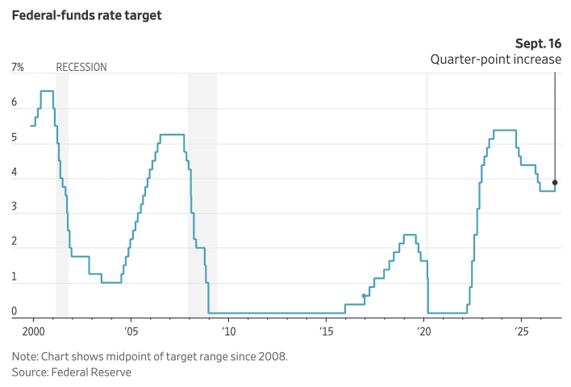
The Federal Reserve raised rates by 25bps at its meeting last week. The move was widely expected by markets, given August’s CPI print. All eyes were on how Fed Chair Kevin Warsh would navigate the situation, as President Trump has made clear he believes rates should be substantially lower, not higher. The FOMC vote to raise rates from 3.75% to 4% was unanimous, a sign of unity from a Fed that is seeking to maintain its independence and credibility. Inflation has now exceeded the Fed’s 2% target for going on six years. At a press conference about the decision, Warsh emphasized the central bank’s focus on getting inflation under control, saying, “Today’s action starts to show that we’re serious about this.” August’s CPI data, released by the Bureau of Labor Statistics earlier this month, showed a 3.4% year-over-year increase. Gas prices continue to be a major driver. Excluding food and energy prices, CPI rose a more modest 2.4% in August vs. the year prior.
CLARITY Falls Short
The CLARITY Act fell short in the Senate last week, failing to secure the 60 votes needed to move forward. The bill attracted 50 votes in favor and 49 against, attracting some support from Democratic Senators who have been more receptive to the crypto industry, while losing some Republicans. The measure, which would establish market and regulatory structures governing cryptocurrencies, touches on a number of areas that cut across various constituencies and party lines. The two elements that have proven the most difficult to resolve center around ethics provisions and stablecoin yield. The ethics provisions and their enforcement mechanisms have proven a sticking point for some Democratic Senators, given President Trump’s and his family’s financial interests in the industry. And while the GENIUS Act, which created a legal framework for stablecoins, speaks to the permissibility of paying interest, banking trade groups are seeking to include measures in CLARITY that would close what they describe as loopholes that allow third-parties, like crypto exchanges and wallets, to pay interest-like rewards on stablecoins balances.
Regulators Propose New TPRM Guidance
Federal banking regulators released new proposed guidance on third-party risk management earlier this month. The proposal, which was jointly issued by the Fed, the OCC, the FDIC, and the NCUA, would rescind and replace existing guidance and supplementary materials. The proposed guidance incorporates regulators’ and supervisors’ experience and lessons learned from overseeing institutions’ third-party relationships. The guidance focuses on a “principles-based” approach and, as regulators have talked about in other areas, emphasizes tailoring and outcomes-based approaches over “check-the-box” exercises. The regulators intend the updated guidance, which is non-binding, to help streamline and create efficiencies in how banks and credit unions work with third-party providers.
In a separate announcement last week, the Fed, the FDIC, and the OCC released a joint statement regarding community banks’ engagement with core service providers. The statement, which does not specifically name any core providers, seeks to address how community banks work with core providers, including in areas like contracting, security incident management, and innovation, and says that the regulators will take such factors into account in how they supervise core providers.
Enova Withdraws Bank Acquisition Applications
Online lender Enova revealed last week that it will not be proceeding with its planned acquisition of Grasshopper Bank. Enova, which offers higher-APR consumer and business loans, had announced in December 2025 it would pay $369Mn to acquire the bank. Enova withdrew its pending applications before the OCC and the Fed, citing a lack of “clear standards” for how regulators evaluate transactions by non-traditional lenders like Enova. Enova’s CEO Steve Cunningham pointed to political and advocacy influence in a statement, saying, “Without clearly articulated standards, the process is susceptible to political pressure and outside advocacy, rather than being guided strictly by the statutory factors that should govern it.” The deal had been opposed by Democratic Senators Elizabeth Warren and Chris Van Hollen, as well as a number of consumer advocacy groups.
OpenAI, Anthropic Roll Out More Financial Services Tools
News, speculation, and commentary about the AI space continues to come at a breakneck speed. Setting aside some of the more alarming news from last week, both major AI labs, OpenAI and Anthropic, have made recent financial services-related product announcements. OpenAI released ChatGPT for Financial Services, which the company describes as combining built-in financial data with the reasoning capabilities of GPT-6 Astra, the company’s latest model. OpenAI worked with Morgan Stanley and Evercore to develop the product, which incorporates data from sources like Daloopa, PitchBook, LSEG News, and Crunchbase. The tool is intended for financial analysts, for example in investment banking or equity research.
Meanwhile, OpenAI chief rival Anthropic released a set of tools targeting financial advisors. The offering, dubbed Claude for Financial Advisors, is intended to help automate financial advisors’ workflow, including client meeting prep, portfolio reviews, and follow ups. The new offering connects with data sources that include Wealthbox, Orion, iCapital, Envestnet, and Zocks. Anthropic’s release follows a similar capability launched by OpenAI earlier this month.
Pave Raises $15Mn Series A
Pave, an AI-powered portfolio manager, announced it has raised $15Mn in an oversubscribed Series A. The round values the company at $100Mn. Pave offers a platform intended to automate manual processes that constrain financial advisors, allowing RIAs to more efficiently scale the volume of assets they manage. Currently, advisors on Pave oversee more than $130Bn in assets through the platform across over 300,000 accounts. Pave gives advisors the ability to manage multi-asset portfolios with granular controls. Pave plans to use the new funding for both its engineering and market-facing teams.
Footprint Announces $25Mn in New Funding
Footprint, which describes itself as an “AI operating system for risk,” announced that it has raised an additional $25Mn in funding. The Series B round was led by QED, with participation from Alumni Ventures, LightBank, Commerce Ventures, MUFG, and others. Footprint focuses on building AI-powered workflows for financial crime compliance, including AML, enhanced due diligence, KYC/KYB, and transaction monitoring. Footprint plans to use the funding to double its engineering and sales teams. Footprint CEO and cofounder Eli Wachs commented on the news, saying, “With this raise, we're doubling down on the thesis that risk operations will be re-envisioned for the AI-native era. As AI expands the volume of financial crime in the global economy, we're building the agentic defense system that can expand to meet and defeat it.”
Fin.com Emerges From Stealth with $20Mn
Fin.com, a global money movement platform, emerged from stealth and announced it has raised $20Mn last week. The seed round was led by Expa and Uber cofounder Garret Camp, with participation from Coinbase Ventures, Tenet Fund, and others. The company aims to solve persistent challenges in cross-border payments, which continue to be a patchwork of local rails, intermediaries, SWIFT, manual processes, and opaque fees and markups, the company says. The company claims its revenue has increased by “50x” since the start of the year, in part through a strategy that is somewhat unusual for a startup: numerous acquisitions. The company said it has already acquired seven companies, and is hoping to complete another five acquisitions by the end of year. This approach, the company says, allows it to more quickly enter local markets by acquiring existing entities that already hold necessary licenses and regulatory permissions.
