Bond Yields Spike; Binance-Circle Deal; Kastle Raises Series A
.png)
The OECD raises 2026 forecast, but lowers 2027’s. Bond selloff spikes yields. New report on SVB failure is released. Charter updates: Avant, Catena, Agora, Bastion. Binance-Circle expand partnership. Kastle Series A. Bill Harris’ new fintech. Sela raises $21Mn.
Agentic commerce is developing fast but consumers don't fully trust AI to make purchases on their behalf. Our Chief Risk & Compliance Officer, Benjamin Melnicki, explores what's needed for consumers to trust agents. Read the full piece here.
Subscribe here to get our newsletter each Sunday. For even more updates, follow us on LinkedIn.
OECD Raises Global Growth Forecast for 2026
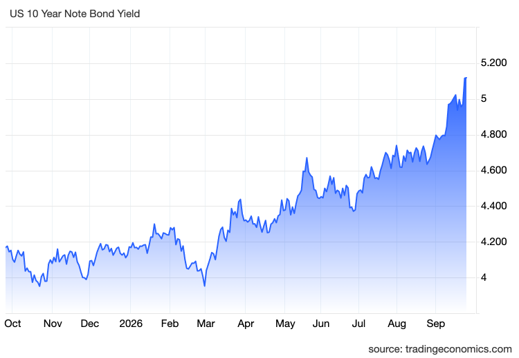
Despite a geopolitical outlook that continues to be turbulent, the latest OECD forecast shows global GDP growing at a faster rate than its June forecast. The group now expects global GDP to increase by 2.9% this year, compared to an earlier forecast of 2.8%. However, higher oil product costs and continuing inflation are expected to impact global growth in 2027, with the OECD forecasting slightly slower growth next year. Inflation remains a global concern, with consumer prices forecast to increase 4.1% across G20 countries, slightly up from an earlier forecast of a 4% increase. While robust demand related to AI has buoyed the U.S. economy, there are concerns the rush to build data centers is crowding out other areas of investment, including in housing, and putting upward pressure on bond yields. A sell off in the bond market last week saw the yield on 10-Year Treasuries reach 5.12%. Yields on Japan’s 10-Year bonds hit 3.075% last week, the highest they’ve been since 1996.
Independent SVB Report Blames Fed
The first of a series of independent reports into the 2023 failure of Silicon Valley Bank was released last week. The bank failed after revealing a $1.8Bn loss on the sale of securities and the need to raise fresh capital just days after the voluntary liquidation of crypto-focused Silvergate Bank. Starling Advisory Group, which was commissioned to prepare the report, pointed to failures in the Federal Reserve’s supervision of the bank. SVB, which catered to the startup and venture capital ecosystem, had an unusually high share of uninsured deposits, with 94% of its deposit base exceeding deposit insurance limits, and a concentrated and highly networked customer base. The Starling report argues Fed supervisors knew, or should have known, the risks SVB presented. An earlier review conducted by now-former Fed Vice Chair for Supervision Barr argued a change in the Fed’s supervision standards following a 2018 law contributed to the situation by driving “a less assertive supervisory approach.” The new report, commissioned by current Fed Vice Chair for Supervision Bowman, disagreed. “The delays in supervisory action were not caused by the regulatory tailoring mandate,” Bowman said in remarks last week.
Charter Race: Avant, Catena, Agora, Bastion
The charter race has continued in recent weeks, with one new application and several fresh conditional approvals. Chicago-area near-prime lender Avant announced earlier this month that it filed an application with the OCC to form Avant Bank, N.A., and a corresponding application for deposit insurance with the FDIC. Avant holds a variety of state licenses and partners with WebBank to offer personal loans up to $35,000 and credit cards with limits up to $3,000. Obtaining its own bank charter would allow Avant to have greater control over its product and customer experience and to expand access to credit using its proprietary decision engine, a company news release says. Avant cofounder and CEO Al Goldstein added, “A national bank charter would further our mission, help reduce our cost of funds, and enable us to offer products under one regulatory framework.”
Meanwhile, three applicants received conditional approvals earlier this month: Catena, Agora, and Bastion. Bastion already operates as a New York trust company, and is seeking to convert to an OCC-regulated national trust. Bastion isn’t a stablecoin issuer itself, but provides tech, operations, and compliance infrastructure for other stablecoin issuers to enable minting, redemption, custody, wallets, and affiliated money movement. Per the conditional approval, Bastion must maintain at least $6Mn of tier 1 capital during the first three years of operation.
Agora, which applied for an OCC national trust bank charter in April, intends to shift issuance of its AUSD stablecoin from Bermuda to the new entity, if final approval is obtained. Requirements of the conditional approval include maintaining at least $10Mn in tier 1 capital and obtaining supervisory non-objection for significant business model changes.
And Catena, led by Circle cofounder Sean Neville, is describing itself as an “AI-native” financial institution. Catena applied for an OCC national trust bank charter in May and intends to offer investment management, digital asset custody, and trust services. The company has described its goal as creating a bank for AI agents and the companies deploying them. Like Agora, Catena’s conditional approval requires it to maintain at least $10Mn in tier 1 equity capital. The conditional approvals allow 12 months for the firms to raise the necessary capital and 18 months to become operational.
Binance Invests $100Mn in USDC-Issuer Circle
Binance has deepened its relationship with USDC-issuer Circle. The crypto exchange announced it has invested $100Mn in Circle and expanded their partnership, focused on promoting the use of USDC, for a five-year term. Binance made the investment in publicly traded Circle via a private placement at a 5% discount to the market price prior to close. According to the announcement, Binance will promote the use of USDC across its platform, particularly in emerging markets. Richard Teng, co-CEO of Binance, commented on the investment and partnership, saying, “We are helping to build a more inclusive, transparent, and compliant digital economy. A stable, trusted digital dollar should not be a privilege – it should be available to anyone with a phone. That's the future this partnership is designed to deliver.”
Kastle Raises Series A
AI-for-banking-ops startup Kastle announced it has raised a $24Mn Series A. The round was led by Insight Partners, with participation from Y Combinator, Commerce Ventures, Fifth Wall, and others. Kastle’s workforce platform aims to streamline banking operations, with consumer lending as an initial focus area. “Enormous volumes” of work necessary to operate lending businesses still run through legacy systems and manual workflows, the company says. Leveraging AI systems can improve speed and efficiencies, but many organizations are struggling to implement such approaches. Kastle’s AI agents have already handled some $1.8Bn in transactions, the company said. Kastle cofounder and CEO Rishi Choudhary commented on the raise, saying, “We give financial institutions an AI workforce that can operate across the systems they already have, so they can capture the benefits of AI now—not five years from now. We believe this will become the safest and fastest way for the world's largest institutions to become AI-native.”
Bill Harris’ New Fintech
PayPal cofounder Bill Harris is back with a new startup. The company, Evergreen.ai, offers an AI-powered financial advice and management app designed to help Americans make better financial decisions. Evergreen.ai covers financial management topics that include day-to-day finances, retirement, investment, and tax strategies. The company describes the offering as bringing “financial techniques of wealthy investors to all Americans.” Currently in beta, users who sign up can use the service at no cost through the end of the year. Evergreen.ai seeks to address the limitations of general purpose LLMs in providing financial advice by incorporating underlying tax and financial math. Evergreen.ai cofounder and CTO Bryan Godwin commented, “Evergreen.ai was engineered specifically to address where general-purpose AI falls short in financial advice. Today, the harness matters as much as the model. Our secure architecture pairs probabilistic Large Language Models (LLMs) that excel at communication, with deterministic software that runs the actual calculations and grounds each answer in current financial and tax knowledge.”
Sela Announces $21Mn in Funding
Sela, which is building AI agents for mortgage sales, announced it has raised $21Mn in seed and Series A funding. The Series A was led by Costanoa, with participation from Emergence Capital. Sela’s AI-powered “loan officers” are already used to help originate more than $1Bn in mortgages per month, the company said, putting the company at a more than $10Mn annualized revenue run rate. Sela describes its AI agents as being able to answer complex questions, educate borrowers, and loop in a human loan officer as necessary. Sela says its agents outperform existing systems, showing a 9% lift in lead-to-rate lock rates. Sela cofounder and CEO Nate Becker explained, “Sela's agents take the best performing sales behaviors, learned across tens of millions of calls, and employ them consistently across every customer interaction.”
