PCE Cools; FedNow Tests Cross-Border Payments; Baselayer Series A
.png)
August PCE came in cooler than expected. JOLTS job openings were about flat month over month. Consumer confidence dips. Fed proposes stablecoin issuer rules. FedNow testing cross-border payments. Valley Bank acquires Bluevine. Pagaya lands $460Mn credit facility. Baselayer raises $35Mn Series A. Stripe acquires Parafin.
We're partnering with GoodLeap to issue the GoodLeap Home Visa Signature Card. The card will be financed by a $50 million revolving credit facility, structured by our Principal Finance Group, and gives homeowners a flexible, lower-cost way to finance home improvement projects. Learn more about the partnership here.
Subscribe here to get our newsletter each Sunday. For even more updates, follow us on LinkedIn.
PCE Better Than Expected
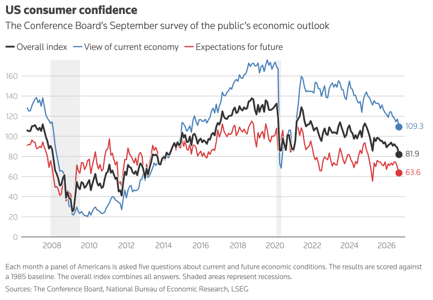
The personal consumption expenditures index, the Fed’s preferred inflation gauge, came in better than expected in August. Overall PCE was up 3.4% year over year vs. an estimate of 3.7%. Excluding more volatile food and energy costs, PCE was up 3% vs. an estimate of 3.3%. While PCE came in below forecasts, there were some minor changes in how the Bureau of Economic Analysis computes the metric. The BEA changed its methodology for measuring the cost of software, legal services, computer accessories, and portfolio management. Unsurprisingly, energy costs were a major driver of price rises in August, with gasoline up 4.4% year over year and transport services up by 1.4%. The JOLTS report showed job openings barely changed in August vs. July, with 7.1Mn open roles. August saw 5.1Mn new hires, 3.1Mn quits, and 1.6Mn layoffs and discharges, per the BLS report. While macro indicators aren’t exactly gloomy, consumer sentiment on the economy is increasingly sour. The Conference Board’s consumer confidence gauge dropped 6.7 points in September to 81.9, its lowest level since 2014. Consumers cited expectations of deteriorating business and labor market conditions, rising interest rates and costs, and the ongoing conflict in the Middle East.
Fed Proposes Stablecoin Issuer Rules
President Trump signed the GENIUS Act, creating a legal and regulatory framework for “permitted payment stablecoin issuers,” into law in July 2025. But rulemaking across the federal banking regulators to nail down the specifics remains ongoing. Toward the end of September, the Federal Reserve officially released two proposals related to the law. The first proposal defines what assets are permissible for backing stablecoins. GENIUS and the proposed Fed rule require stablecoin issuers to hold high-quality short-duration liquid assets, such as Treasury bills and bank deposits, to back the stablecoins they issue. The proposal also defines standardized capital requirements, credit and operational risks, and risk management standards. The rule also creates rules for how Fed-supervised firms handle custody and safekeeping of assets backing stablecoins. The second proposal the Fed issued defines a tailored application process for Fed-supervised banks that want to issue stablecoins. Applicants must submit a business plan, financial information, and related documents. The proposed rule also creates a process governing appeals, hearings, and final determinations. Interested parties have 60 days to comment on the proposed rules.
FedNow Testing Cross-Border Capability
FedNow, the instant payment rail operated by the Federal Reserve, will soon support cross-border transactions. The new capability will enable banks and credit unions that have integrated FedNow to support transactions that involve parties outside of the United States. FedNow will handle the U.S. leg of the transaction, while the foreign leg will be handled by a correspondent bank. The Fed described this structure as being aligned with existing payment industry standards. A number of unspecified early adopters will begin testing the new payment message format that was built to facilitate the domestic component of these transactions. The Fed described possible use cases as including global treasury management, payroll, corporate payments, and insurance claims.
Valley Bank Acquires Bluevine
Valley National Bank is acquiring small business banking startup Bluevine, the companies announced last week. Valley will pay $340Mn for the company in cash and stock. Bluevine had raised around $280Mn in equity and pivoted through multiple business models. The company originally started out offering invoice factoring. The company later added term loans, business lines of credit, and banking products via a partnership with Coastal Community Bank and sold off the invoice factoring business. Bluevine’s 175,000 customers and their approximately $2.1Bn in deposits will move to Valley in the first half of next year, Valley CEO Ira Robbins said during a conference call about the deal last week. Robbins commented on the acquisition, saying, “Rather than waiting for chartered fintechs to compete with us for small business banking relationships, we are proactively combining Valley’s banking foundation with Bluevine’s digital growth engine.” Bluevine’s cost of funds, at 1.44% vs. Valley’s 2.28%, was no doubt part of the appeal of the acquisition. Bluevine CEO Eyal Lifshitz will join Valley as its head of small business banking.
Pagaya Lands $460Mn Revolving Credit Facility
Second-look lending network Pagaya has announced a new $460Mn revolving credit facility. The 24-month revolver will enable Pagaya to deploy as much as $850Mn in credit through its network of lending partners by reinvesting excess cash to purchase new collateral over the revolving period. The new facility complements a 2024 deal for a five-year $280Mn senior secured facility supported by BlackRock, UBS O'Connor, JP Morgan Chase, Valley Bank, and Israel Discount Bank. Pagaya CEO Gal Krubiner commented on the deal, saying, “You can expect us to expand more into these structures, like our recently announced auto forward flow, providing not just access to capital but higher visibility into future funding capacity.”
Baselayer Raises $35Mn Series A
“Know your business” startup Baselayer has announced it raised a $35Mn Series A. The round was led by M13, with participation from Torch Capital, Picus Ventures, Afore Capital, and others. Baselayer offers business identity verification and risk infrastructure to enable banks, fintechs, and other firms to help underwrite credit and prevent fraud. Now, the company is expanding its tech to include agent identity, which some are already referring to as “Know Your Agent.” Baselayer is developing an identity layer to allow merchants, banks, and financial institutions to understand when and in what capacity an agent is authorized to act on a consumer’s or business’ behalf. Baselayer cofounder and CEO Jonathan Awad explained, “Every era of commerce has required a new trust layer, but historically that infrastructure gets built only after fraud and abuse make the problem impossible to ignore. Agentic commerce is moving too fast for the industry to repeat that mistake.”
Stripe Acquires Parafin
Stripe is acquiring small business financing infrastructure platform Parafin. Parafin’s tech sits behind financing programs embedded in well-known platforms like Gusto, Amazon, DoorDash, Jobber, Fullsteam, and dozens of others. Since its first cash advance in 2021, Parafin has extended more than $3Bn in credit to more than 60,000 small businesses across the U.S. and has expanded to offer term loans, BNPL, and credit cards. In explaining the decision to join Stripe, Parafin said in a company blog post, “Joining Stripe will accelerate everything on our roadmap. Stripe works with millions of businesses and the platforms that serve them, in markets beyond our reach today.”
