July’s Jobs Report; Revamped Deposit Insurance Process; eToro Acquires Tradezero
.png)
July’s bleak jobs report. Inflation ticks down, slightly. UBS’ BSA settlement. FinCEN ends beneficial ownership reporting requirement. FDIC revamps deposit insurance application process. Bunq’s charter hopes dashed. Zaria applies to form national trust bank. eToro to acquire Tradezero.
We’re proud to have co-led a financing round for inKind’s second financing tranche, committing $150 million. Through this commitment, we’re enabling inKind to expand the capital foundation behind its commerce platform and help high-quality restaurants access growth capital. Read more here.
CRB Securities’ Investment Banking team served as exclusive financial advisor and placement agent to Edge Focus on its equity capital raise led by Atlas Merchant Capital LLC. Edge Focus is a living version of the single conviction Cross River was built on: technology that is deployed responsibly and expands access to the financial system.
New here? Subscribe here to get our newsletter each Sunday. For even more updates, follow us on LinkedIn.
July’s Jobs, Inflation Data
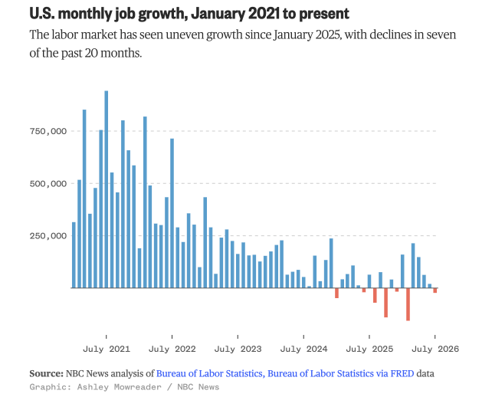
The July jobs report came in last week, and it wasn’t a good one. Analysts had expected the Bureau of Labor Statistics report to show the economy had added 83,000 jobs last month. Instead, the report revealed the economy lost 23,000 jobs in July. The most recent report also downwardly revised data points for May and June by a combined 103,000 jobs, painting a materially weaker picture of the U.S. labor market than was previously thought. Wage growth has also stagnated, with workers’ earnings up just 0.1% in July vs. the month prior, or 3.2% year over year, failing to keep up with inflation. While the headline unemployment rate actually ticked down slightly, to 4.1%, that change is primarily being driven by workers who have stopped looking for work and left the labor force altogether. The labor force participation rate stands at 61.4%, which, apart from the COVID era, is a multi-decade low.
The BLS also released July’s CPI print last week. The report showed a 0.1% month-over-month increase in prices on a seasonally-adjusted basis. That means July’s year-over-year inflation number came in at 3.4%, down slightly from June’s 3.5%, but still well above the Fed’s long-term 2% target. Excluding more volatile food and energy prices, which have been impacted by the ongoing conflict in the Middle East, inflation ran at 2.5% year over year in July. The seemingly weakening labor market combined with persistent inflation have the potential to put the Fed in the enviable position of having to prioritize one part of its dual mandate over the other.
UBS Hit with $125Mn BSA Fine
Earlier this month, U.S. financial regulators hit UBS with fines totaling $125Mn for violations of the Bank Secrecy Act, the largest-ever civil fine against a broker-deal for violating anti-money laundering laws. The new settlement isn’t UBS first run-in with U.S. regulators. The Swiss bank was previously fined $14.5Mn by FinCEN over similar issues in late 2018. The new action stems from conduct between mid-2019 and mid-2023. UBS status as a “repeat offender” helps explain the larger-than-normal financial penalty. In the new settlement, UBS admits to willfully violating the BSA by failing to implement and maintain an anti-money laundering program and by failing to file suspicious activity reports. Regulators allege UBS failed to conduct sufficient customer due diligence on high-risk customers, including those with ties to Russia and other sanction jurisdictions, and failed to monitor over 60,000 cross-border transactions totaling more than $10Bn. The settlement resolves investigations from multiple federal agencies, including FinCEN, the SEC, the CFTC, and Finra.
FinCEN Rule Ends Beneficial Owner Registry for U.S. Entities
FinCEN released a final rule last week that effectively ends the Corporate Transparency Act’s requirement that U.S. legal entities file information with the financial crime regulator identifying their beneficial owners. The rule would have required legal entities to furnish information including name, birth date, and other identifying details on beneficial owners who own or control 25% or more of the entity. The reporting rule was mandated as part of the Corporate Transparency Act, which was passed as part of the National Defense Authorization Act with strong bipartisan support. As part of the rollback, FinCEN said it will delete all data previously provided by U.S. entities. Treasury Secretary Bessent called the move a “victory for common sense and American small businesses,” and added, “President Trump promised to cut red tape, and this final rule delivers. Treasury is eliminating a burdensome reporting requirement for millions of law-abiding business owners without compromising our national security.”
FDIC Revamps Deposit Insurance Application Process
Last week, the FDIC announced a revamped deposit insurance application process. The move comes amid something of a renaissance in de novo bank formation, though many current applicants are seeking to form national trust banks, which do not hold insured deposits. The announcement detailed a new two-phase application process that is intended to further encourage new bank formation, accelerate the review process, and improve the efficiency of the application process. The new approach entails providing de novo applicants “contingent authorization” within 120 days of receiving an application and full approval within the subsequent 12 months upon receiving additional information and the completion of key organizational steps. The new process will provide groups attempting to form new banks more clarity in a shorter timeframe, giving them better visibility before embarking on the process of raising capital, hiring staff, and setting up necessary banking infrastructure. The new process is intended to generally allow applicants to concurrently file a deposit insurance with the FDIC and their corresponding charter application with the relevant chartering authority, whether the OCC or a state banking regulator.
FDIC Chairman Travis Hill commented on the revised application approach, saying, “Improving the de novo process and encouraging more new bank formation has been a key priority for the FDIC. Today’s action is one of several steps the FDIC has been working on in furtherance of this goal. A healthy pipeline of new entrants is critical to the long-term vitality of the banking sector, particularly for community banks.”
Bunq Charter Denied, Zaria Applies To Form National Trust Bank
Just because the “charter window” is open, doesn’t mean every application will be approved. Cross-border payments firm Wise saw its application to charter a national trust bank declined in late July, with the publicly released denial pointing to a multi-state action stemming from Wise’s AML practices. And, last week, Amsterdam-headquartered digital bank Bunq received word that its application for a full-service deposit-taking OCC charter would not be granted. Bunq had previously applied for an OCC charter in 2023, before withdrawing its application in 2024. The denial letter indicated that Bunq’s proposed capital structure was inadequate for its proposed business plan, that its organizers, board, and management lack adequate experience, and that its suggested path to sustainable profitability was “unrealistic.”
In other charter-related news, another crypto-related firm is seeking to charter a national trust bank. Zaria Systems, which builds technology infrastructure for credit and structured finance, is the latest company to apply for such a charter. Zaria’s application to form Zaria National Trust Bank was submitted on July 31st and has a public comment period running through the end of August. Zaria explained in a press release that the charter would allow it to bring federally-regulated fiduciary infrastructure to the structured finance market. Zaria cofounder and CEO Emily Barron explained, “Lenders, asset managers and their investors increasingly need a fiduciary counterparty that can monitor collateral in real time, not just at the end of a reporting period. Filing for a national trust bank charter allows us to build that infrastructure inside a federally regulated institution, so lenders and their counterparties get the same regulatory clarity and credibility they already expect from a bank, applied to markets that have never had it before.”
eToro to Acquire TradeZero
Brokerage and crypto platform eToro is set to acquire TradeZero, accelerating its expansion into the U.S. market, the companies announced last week. TradeZero was founded in 2015 and operates across the U.S., Canada, and other international markets, specifically seeking to serve “active” traders. Per eToro, the expected total consideration for the deal could be as much as $231Mn in cash plus an additional equity consideration of 2.5Mn newly issued shares (eToro is publicly traded). The deal is expected to close in the first half of 2027, subject to customary regulatory review and closing conditions. eToro cofounder and CEO Yoni Assia commented on the deal, saying, “Today's announcement is an important step in building our US business. TradeZero has built a successful franchise, with differentiated technology, broker-dealer infrastructure and a highly engaged trading community. This combination gives us a faster path to launching new products for US customers and strengthens our offering.”
