Inflation at 4.2%; Deposit Insurance Assessment Changes; Ramp Worth $44Bn
.png)
BLS jobs report looks good, but CPI print looks bad, putting Fed Chair Warsh in tough spot. Trump nominates new CFPB leader. FDIC proposes deposit insurance assessment changes. Klarna launches U.S. savings accounts. Ramp now worth $44Bn. Current raises $80Mn Series E, eyes public offering. Figure acquires real estate lending platform.
Everyone's still focused on UX, but the real battle has moved to infrastructure. Our Head of Digital Assets, Luca Cosentino, shares insightful advice here.
New here? Subscribe here to get our newsletter each Sunday. For even more updates, follow us on LinkedIn.
Inflation Hit 4.2% In May
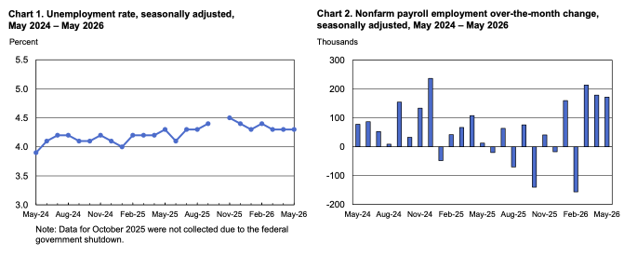
The latest Bureau of Labor Statistics data, which was released on Friday, June 5th, was broadly consistent with the earlier ADP private payroll data for May. The BLS data showed non-farm payroll increased by 172,000 in May. The unemployment rate remained unchanged at 4.3%. Per the BLS report, job gains were concentrated in leisure, hospitality, local government, and health care. Macro analysts have pointed out that temporary hiring in advance of the World Cup, which began last week, is likely providing a tailwind to employment numbers.
Meanwhile, May’s CPI print came in last Wednesday, June 10th, and inflation is running hot. Prices were up 4.2% year over year, which was consistent with forecasters’ expectations. Core CPI was up 0.2% month over month, or a 2.9% increase year over year using the more narrowly defined metric. Unsurprisingly, energy expenses were the main culprit, rising 3.9% in May vs. the month prior. Energy costs accounted for a whopping 60% of the overall rise in price levels in May. And remember, these numbers are before last week’s renewed hostilities in the Middle East, which are casting fresh doubt on when a deal to reopen the Strait of Hormuz could be reached. The good jobs numbers and bad inflation numbers are putting new Fed Chair Kevin Warsh in a tough position. While Warsh has, historically, been viewed as an inflation hawk, President Trump has often made clear his preference for lower rates. But with the employment market appearing to be steady and climbing inflation, Warsh will have a very tough time making a plausible case for a rate cut. Indeed, markets are already pricing in one or possibly two rate hikes by the end of 2026.
Trump Nominates New Leader for CFPB
In an unexpected move, President Trump has nominated a former Consumer Financial Protection Bureau leader and current Capital One executive to be the bureau’s new director. Acting Director Russ Vought has led the CFPB since Trump fired Biden-appointed Rohit Chopra shortly after Trump took office. The nominee, Brian Johnson, held the number two post at the CFPB from 2018 to 2020. During his time at the bureau, he led the formation of the Taskforce on Federal Consumer Financial Law, the Office of Innovation, and the Start Small, Save Up emergency savings initiative. Johnson’s nomination to lead the CFPB will require Senate confirmation, where he’s likely to face tough questioning from Democrats about the administration’s handling of the consumer regulator to date.
The CFPB did choose to wade into a recent, relatively high-profile case of alleged consumer harm. The Bureau issued a statement regarding housing rewards and neighborhood loyalty startup Bilt and its handling of its migration between bank partners. Bilt also offers a credit card through partnerships with Cardless and Column. Bilt users complained about a litany of issues during the transition to “Bilt 2.0,” including housing payments that were debited from external accounts but that were delayed in reaching or never were paid to mortgage servicers and landlords. Senator Elizabeth Warren (D-MA) sent Bilt CEO Ankur Jain a letter regarding the company’s handling of the issue and posing a number of questions.
For its part, the CFPB has essentially signaled it doesn’t intend to pursue an enforcement action over the matter. The bureau did release a statement saying in part, “The CFPB has been working to ensure consumers affected by Bilt’s transition to a new bank partner are appropriately remedied. CFPB officials met with Bilt to understand the issues caused by the transition and what steps Bilt has taken to ensure customers affected by challenges with the transition were made whole.” The statement described the approach as a “collaborative process” that illustrates its new enforcement principles.
FDIC Chair Proposes Deposit Insurance Assessment Changes
The FDIC is proposing a change that could allow some of the country’s largest banks to reduce how much they pay into the deposit insurance fund. FDIC Chair Travis Hill explained last week that, if larger banks take steps to ensure they are easier and less costly to wind down in the event of failure, the agency could reduce the quarterly insurance premiums they pay. While this “resolution readiness” would apply only to larger banks, Chair Hill intends for proposed changes to reduce insurance costs for both larger and smaller institutions, with the goal being to free up capital. Chair Hill said, “We are mindful of the costs of assessments, which, among other costs, effectively take funds away from lending and investing in the real economy and divert them to financing the federal government.”
Klarna Launches U.S. Savings Accounts
Buy now, pay later provider Klarna announced its launching savings accounts in the U.S. Klarna, which holds a banking license in its home country of Sweden, will partner with Utah-based WebBank on the savings account offering. The launch follows Klarna’s launch of a debit card product, which enables users to either pay-in-full at the time of purchase or opt to spread payments over time. The rate of interest Klarna offers on the new savings accounts is tied to what membership tier a user opts for. Users that don’t choose to pay a monthly membership fee earn a base rate of 3.28% APY on balances up to $50,000, while those with a paid membership can qualify for higher rates.
Ramp Now Worth $44Bn
Business banking startup Ramp has raised $750Mn round at a $44Bn valuation. That’s nearly triple what the company was valued in early 2025. The latest funding round was led by ICONIQ, GIC, and the Ontario Teachers’ Pension Plan. New investors in the round included D.E. Shaw, Goldman Sachs Alternatives, Morgan Stanley Investment Management, BroadLight Capital, and Insight Partners. Ramp said its annualized revenue exceeds $1Bn, as of last September. Ramp also has said that it is free cash flow positive. Ramp, whose initial product set focused on expense management, now offers a suite of products that include procurement, vendor management, payments, fraud, and accounting. Like plenty of other fintechs, Ramp has also been leaning into the AI narrative. In the company’s announcement, Ramp CEO Eric Glyman commented, “For 500 years, business ran on two pillars of spend: people and vendors. In the last 24 months, a third arrived – intelligence, paid by the token and invisible to every system we've built to manage cost. Ramp is the infrastructure for the third pillar.”
Current Raises $80Mn Series E, Eyes Public Offering
Neobank Current announced last week that it has raised an $80Mn Series E. The round was led by Springcoast Partners and builds on previous backing from investors that include Avenir, Foundation Capital, Tiger Global Management, Andreessen Horowitz, QED, and others. As part of the latest round, Springcoast Partners will join the company’s board of directors. The new investment values Current at $1.5Bn. Concurrent with the equity raise, the company announced it has expanded its financing facilities with Cross River and General Catalyst, increasing Current’s ability to scale credit products to meet customer demand. The company has had three consecutive years of 70% growth and is focused on hitting profitability in 2026. Current hinted at a prospective IPO, saying in its announcement that the company “continues building the operational scale, governance, and financial profile expected of a public company.” Current cofounder and CEO Stuart Sopp commented on the fundraise, saying, “Over the last several years we've focused relentlessly on building products that solve real financial problems for everyday Americans. That focus has driven three consecutive years of more than 70% growth, strong unit economics, and a crossing over to profitability.”
Figure Acquires Real Estate Lending Platform
Figure, the blockchain-based lender, announced plans to acquire real-estate lending platform Kiavi, the two companies announced last week. Kiavi originates short-term residential loans and longer-term debt service coverage loans. Kiavi’s volume is expected to add about $7Bn to Figure’s balance sheet immediately following the purchase. Sixth Street and Figure will also create a joint venture to buy loans off of Kiavi’s balance sheet. The total transaction price is $717Mn, according to the companies’ announcement. Figure CEO Michael Tannenbaum commented on the deal, saying, “Figure is relentless in our pursuit of moving the capital markets onto blockchain rails, and nine months past our successful IPO, this Kiavi transaction is a further pole vault into tokenization, first-lien diversification and our agentic AI platform.”
