Consumer Confidence Dips; Trump Fintech E.O.; Mercury Raises $300Mn
.png)
We’re back after taking the week off for the Memorial Day holiday.
U.S. consumer confidence dropped. Food prices set to rise. President Trump issues executive order on fintech. Relay raises $50Mn. Wealth management startup Further announces Series D. “AI native” bank Catena Labs scores $30Mn in new funding. Mercury’s $300Mn Series D. Capchase inks $174Mn debt facility deal. Bench Accounting founder’s second act.
And, in case you missed it last week, we’re out with our Q1 2026 consumer lending review, covering earnings, originations, and credit data across the personal loan, BNPL, cash advance, high APR, and second look categories, as well as an increase in marketplace lending new issuance volume.
New here? Subscribe here to get our newsletter each Sunday. For even more updates, follow us on LinkedIn.
Consumer Confidence Dips
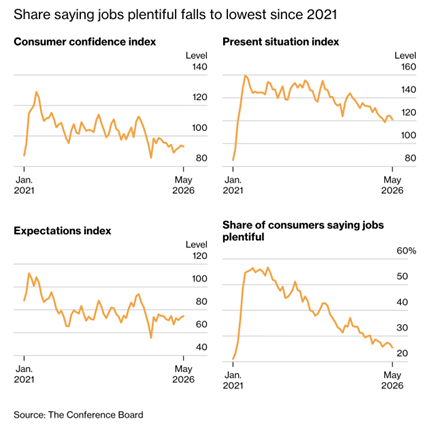
Americans’ confidence in the state of the economy edged down in May, as fallout from the ongoing war in Iran increasingly comes into focus. The Conference Board’s latest data, from a survey conducted from May 1-19, shows consumer confidence decreased by 0.7 to 93.1, slightly above forecasters’ expectations of 92. Still, the report’s gauge of present conditions dropped by 3.2 points to a three-month low. The biggest factor in waning consumer confidence appears to be rising prices at the pump. According to the survey, some two-thirds of consumers have reported cutting back on spending due to rising prices. Tax refunds have helped support household budgets, but the impact of such payments typically only lasts a couple of months at most. Consumer concerns about the job market are evident, with the proportion of respondents who said that jobs are “plentiful” hitting the lowest level since 2021.
Somewhat perplexingly, the share saying jobs were “hard to get” also moved lower. The survey did show that Americans expect more jobs to be available in the next six months, indicating respondents may view the current period as a temporary rough patch rather than a new normal. Still, there may be more challenges ahead. Forecasters expect prices for a range of staple grocery items to increase in the coming months, owing to a combination of tariffs, bad weather (including a potentially strong El Niño phenomenon), the conflict in the Middle East, and shrinking cattle herds.
Executive Order on Fintech
President Trump signed an Executive Order on fintech last week. The measure, officially titled “Integrating Financial Technology Innovation Into Regulatory Frameworks,” aims to facilitate and promote the adoption of financial technology within the U.S. banking and financial system. The order lays out the administration’s policy, directing regulators to “update regulations to allow integration of digital assets and innovative technology into traditional financial services and payment systems.” The E.O. further directs the government to “remove overly burdensome and fragmented regulations and supervisory practices that form barriers to entry and primarily benefit incumbent financial services firms.” Perhaps the most interesting and potentially impactful part of the order is aimed at the Federal Reserve, which, historically, has enjoyed broad independence. The E.O. requests that the Fed evaluate the legal, regulatory, and policy framework around granting access to Fed master accounts by uninsured depositories and non-bank financial companies, including those involved in “novel” financial activities and digital assets. The order specifies that, if the Fed determines the law allows for the extension of Fed payment services to additional types of entities, that the Fed establishes transparent application procedures for those seeking access and that those applications be decisioned within 90 days of receipt.
Relay Bags $50Mn for Customer Growth
Relay, a Canada-based business banking startup, announced it has raised $50Mn in new funding. The capital is being provided by General Catalyst’s Customer Value Fund. Relay intends to use the money to increase customer acquisition. The funds come with an unusual structure. The design of General Catalyst’s Customer Value Fund is such that the fund provides capital for customer acquisition (e.g., sales and marketing expenses), without the firms that receive the money needing to give up equity. In return, General Catalyst receives a portion of any revenue generated by the new users. In this structure, General Catalyst owns the downside, if customer acquisition programs aren’t effective. Relay described the structure as eliminating the typical "growth-vs-burn tradeoff" faced by most startups.
Farther Raises $150Mn Series D
Farther, a digital wealth management startup, announced that it has raised a $150Mn Series D. The fundraising round was led by General Atlantic and was further supported by what the company described as an undisclosed number of existing investors. The official valuation figure was not disclosed, but Farther did specify that the company has joined the “unicorn” club, meaning that its valuation exceeds $1Bn. Farther’s platform leverages automated advisory technology and human advisors to manage customers’ portfolios and cash. The platform integrates algorithms to automate and optimize administration, including tax-loss harvesting and portfolio rebalancing. Farther said it has $23Bn in “recruited assets,” which includes current assets under management and expected assets from future advisor acquisitions.
Farther cofounder and CTO Brad Genser commented on the fundraise, saying, “We never aspired to deliver incremental improvements to wealth management – so we rebuilt it from the ground up. Our platform replaces fragmented, legacy systems with a single, integrated solution that powers advisors to operate more efficiently and effectively, with better outcomes for clients.”
Catena Labs Raises $30Mn for “AI-Native” Banking
A cofounder of USDC issuer Circle, Sean Neville, is on to his next startup: Catena Labs. The company, which is building capabilities to allow AI agents to safely execute financial transactions, announced that it has raised $30Mn. The round was led by Acrew Capital and Andreessen Horowitz’s crypto fund, a16z crypto. Other investors in the round include General Catalyst, QED, and Breyer Capital. Catena Labs previously took $18Mn in funding from a16z crypto last year. Catena Labs did not disclose the valuation at which it raised the funds. Neville commented on the fundraise and the company’s vision to Fortune, saying, “It’s very early days. I think the main learning has been, as we evolved from thesis to reality and moving real money, is that giving an agent a wallet is pretty easy compared with giving a business a governed way to trust it.”
Mercury’s $300Mn Series D
Business banking startup Mercury also announced new funding last week. The company, which has received conditional approval to charter a bank, raised a $200Mn Series D. The round was led by TCV, with participation from existing investors that include Sapphire Ventures, Sequoia, Spark Capital, Andreessen Horowitz, Coatue, and CRV. The new funding brings Mercury’s total primary and secondary funding to approximately $700Mn. According to the company, it reached $650Mn in annualized revenue in Q3 of last year and has continued to “grow rapidly” since then. The company is also profitable on an EBITDA and GAAP net income basis, Mercury said in its announcement. Mercury is developing what it describes as “a new way to complete financial work end-to-end with AI,” dubbed Mercury Command. Mercury cofounder and CEO Immad Akhund commented on the news, saying in part, “AI is collapsing the friction between an idea and a company faster than anything I have seen in my career… I started Mercury because banking should do more than be a vault, it should help customers run the best business possible.”
Capchase Ready for Growth with $174Mn Credit Facility
Capchase, which some describe as the “Affirm for B2B,” announced it has raised $26Mn in new funding and secured a $174Mn credit facility. The equity round was led by 01 Advisors, with participation from Bling Capital, Scifi VC, Caffeinated Capital, Thomvest Ventures, Invesco, and others. While Capchase began by offering “revenue-based financing” targeting at SaaS firms, it has evolved its product and now describes it as a “vendor-financing technology platform.” Capchase’s offering is embedded in sales workflows to enable vendors to offer their customers financing as part of the sales process. Capchase cofounder Miguel Fernandez described the vision, telling Crunchbase News, “We started to see that there was a very big pull in the market,” Miguel Fernandez, co-founder and CEO of Capchase, said in an interview. We saw that sales cycles were expanding, CAC was going up, and all of this was driven by the high interest rates. Buyers wanted to pay as late as possible and pay installments.”
Bench Accounting Founder’s Second Act
The founder behind Bench Accounting, which abruptly collapsed in 2024, is back. Ian Crosby is taking a second pass at building a company that automates bookkeeping and accounting. The new firm, Synthetic, intends to build an AI-powered accounting platform that can create accrual-based accounts without human input. Crosby has raised a $10Mn seed round for the new venture. The round was led by Khosla, with participation from Basis Set Ventures and Shopify CEO Tobias Lütke. Describing his plans to TechCrunch, Crosby said, “We’re not going to release anything that’s not fully autonomous. It’s that or bust.”
